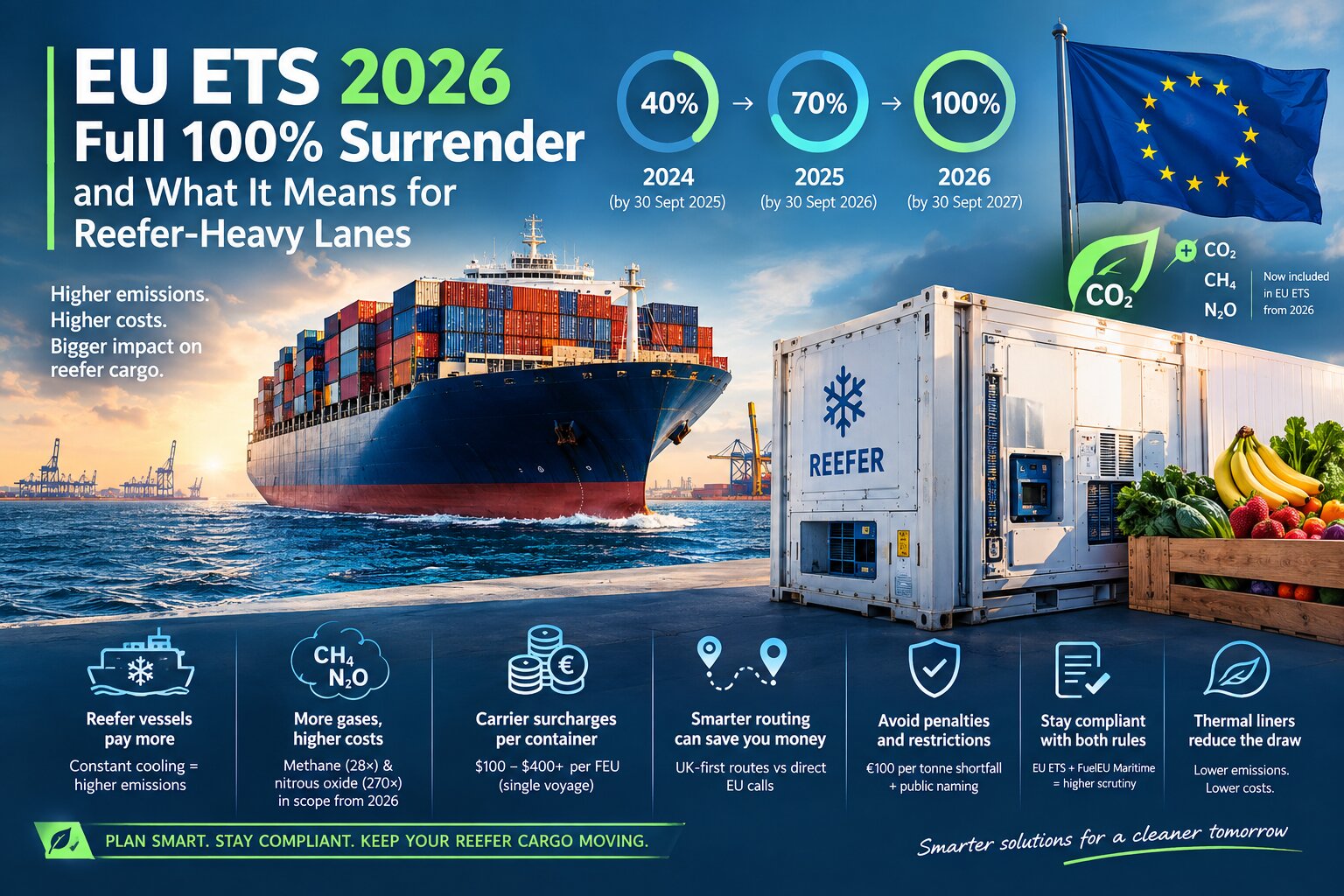

The EU F-Gas Phasedown Steps Reefer Operators Should Be Planning For Now
Most reefer operators believe the EU has banned their refrigerant. The belief is wrong. No prohibition in the F-Gas Regulation names refrigerated containers anywhere. Your costs still climb every single year, and the reason sits in a quota table rather than a ban list.
Does The F-Gas Regulation Ban Your Reefer Refrigerant?
No. You should start there, because half the trade press says otherwise.
Regulation (EU) 2024/573 took effect on 11 March 2024 and replaced the 2014 rules. Annex IV of that regulation lists every product and equipment ban. Refrigerated containers do not appear on the list.
One widely shared article from a German container trader states that reefer units fall under the 150 GWP limit from 1 January 2025. The claim confuses two separate categories. The 150 limit covers self-contained commercial and domestic refrigeration, such as shop cabinets, ice makers and blast chillers.
Transport refrigeration sits outside Annex IV altogether. Refrigerated trucks, trailers, light vans, train wagons and intermodal reefer containers all escape the placing-on-market bans. So why should you care at all? Because the Regulation reaches you through three other doors.
The squeeze arrives through quota, price and servicing. No ban required.
How Does A Law That Never Names Reefer Containers Still Reach Your Plug Sockets?
The EU caps how much HFC refrigerant may enter the market each year. The cap falls in steps. Suppliers then ration what they sell, and prices move.
Numbers make the point faster than argument does. The quota for 2025 and 2026 together sits at 42,874,410 tonnes of CO2 equivalent. The same measure stood at roughly 82.3 million tonnes in 2023. You have watched a 48 percent cut land inside two years.
The next step arrives on 1 January 2027. The quota for 2027 to 2029 drops to 21,665,691 tonnes of CO2 equivalent. Supply halves again.
Now note how the EU counts the cap. Quota gets measured in CO2 equivalent, never in kilograms. Quantity multiplied by global warming potential gives the number. A high-GWP gas therefore eats quota far faster than a low-GWP one.
Your R-134a charge carries a GWP of 1,430. Every kilogram you buy consumes 1,430 times its own weight in quota. R-404A carries 3,922. You can work out which gas suppliers drop first.
Which Dates Belong In Your Maintenance Diary Right Now?
Nine dates matter to a reefer fleet. Put them in the diary today, because several have already passed and the rest arrive faster than a fleet renewal cycle.
What Happens To Your R-404A Units On 1 January 2026?
You lose the legal supply of new gas. From that date the EU bans placing any fluorinated gas above GWP 2,500 on the market. R-404A sits at 3,922, so it goes.
Older reefer machinery and shore-side plant still runs R-404A. You have kept it alive on reclaimed stock since 1 January 2025, when the servicing ban on virgin gas above GWP 2,500 began. The 2026 date closes the market completely.
Reclaimed and recycled gas stays legal until 1 January 2030. You should treat the gap as a four-year runway rather than a reprieve.
So what should you do? Count your R-404A units now. Decide which ones retrofit and which ones retire. A unit that needs a major gas charge in 2029 has no future worth funding.
What Will A Cylinder Cost You By 2027?
Price tells the story faster than regulation does. A 10 kilogram cylinder of R-404A now costs between 446 and 499 euro across the EU. The spread depends on reclaimed against virgin stock.
Recall what happens on 1 January 2027. Available quota halves. Suppliers hold less gas and sell it to whoever pays most.
You should model two numbers before you sign the next service contract. Model the gas price. Model the labour hours to recover, reclaim and recharge.
Here is the sum worth doing today. Read the nameplate charge on one of your units. Multiply the kilograms by today's cylinder price, then multiply again by the number of units due a full recharge this year. The figure that falls out is your 2027 exposure, and it only rises from there.
What Could The Commission Decide On 1 July 2027?
One date matters more than all the others. The Regulation orders the Commission to report by 1 July 2027. The report must assess whether transport refrigeration and mobile air conditioning belong among the Annex IV bans.
You should read the sentence twice. Reefer containers escaped the current bans. The escape lasts only until that review says otherwise.
Think about your order cycle for a moment. A reefer container works for 12 to 15 years. A box you order in 2027 still runs in 2040. You therefore need a view on the review before you place the order, not after it lands.
What would a ban actually look like? Expect a GWP ceiling on new units placed on the EU market, with a lead time of several years. Expect existing boxes to keep running. Expect resale value on high-GWP units to fall the day a proposal publishes.
A box ordered in 2027 still runs in 2040. You need a view on the review before you order, not after.
Can You Still Sell An Old Reefer Box Outside Europe?
Residual value carries a new risk. From 12 March 2025 the EU bans the export of equipment charged with F-gases at GWP 1,000 or above, where the same equipment cannot be placed on the EU market. The rule targets dumping. Europe does not want obsolete kit pushed into developing markets.
Check your fleet against the threshold. R-404A at 3,922 clears it easily. R-134a at 1,430 clears it too. R-513A sits at 631 and stays safely below.
A further door closes in 2028. Trade in HFCs, either in bulk or inside equipment, ends with countries outside the Kigali Amendment. Your buyer list shrinks again.
What Paperwork Must You Hold Before A Reefer Crosses The EU Border?
Compliance now begins at customs. Anyone who imports equipment pre-charged with F-gases needs registration on the EU F-Gas Portal. The requirement applies regardless of how much gas the unit holds.
You also need a valid import licence. Customs clearance fails without one. Your declaration must then carry the detail. Record the F-gas type, the GWP, the quantity and the origin.
What goes wrong when you skip a step? Boxes sit at the port. Fines follow. A missing portal registration can stop you placing the equipment on the market at all.
How Often Must You Check Each Unit For Leaks?
Leak checks scale with CO2 equivalent, never with kilograms. Charge size multiplied by GWP sets your interval. The arithmetic punishes high-GWP gas twice over. You pay more for the gas. You then pay more in labour to inspect it.
A worked comparison shows the effect clearly. Two units hold the same 6 kilogram charge. One runs R-404A at GWP 3,922, so the calculation returns roughly 23.5 tonnes CO2 equivalent. The other runs R-513A at GWP 631, so the identical charge returns about 3.8 tonnes.
The first unit lands inside the mandatory check regime, which starts at 5 tonnes CO2 equivalent. The second unit falls below the threshold and escapes the interval altogether. Same box, same cargo, different paperwork bill.
Which Refrigerant Should Your Next Order Use?
Four options sit on the table today, and only two of them ship in volume.
Read the table as a sequence, not a menu. R-513A buys you a decade. R-744 answers the 2027 review, once someone ships it at scale.
What Should You Do In The Next Ninety Days?
- Count every unit by refrigerant type and nameplate charge
- Convert each charge to CO2 equivalent and sort the fleet by that number
- Flag every R-404A unit and set a retire or retrofit date before 2030
- Ask your gas supplier to quote reclaimed and virgin separately for 2027
- Check your F-Gas Portal registration and import licence remain valid
- Ask your OEM what their 2027 unit will run on
- Review resale assumptions on any unit above GWP 1,000
- Diarise 1 July 2027 and assign someone to read the report
Which Cargo In Your Reefers Never Needed One?
End on the question nobody in the reefer trade enjoys. Every step above raises the cost of running a refrigerated box. None of the steps raise the cost of running a dry one.
Some cargo books a reefer because a reefer is the safe default. Chocolate, wine, beer, milk powder, packaged food and bulk ingredients often need a stable range rather than a set point. A passive insulated liner holds that range without power, without gas and without a quota. Our technicians fit it inside a standard dry container in roughly 7 to 20 minutes.
You should not read the paragraph as an argument against reefers. Frozen cargo needs a reefer. Fresh produce needs a reefer. Validated pharmaceutical cargo needs a reefer, and nothing here changes that.
Ask a narrower question instead. Which lanes in your book carry ambient cargo inside refrigerated equipment? Every euro the F-Gas phasedown adds makes that answer more expensive to ignore.
Frequently Asked Questions
Does the EU F-Gas Regulation ban reefer containers?
No. Annex IV of Regulation (EU) 2024/573 lists the equipment bans, and transport refrigeration does not appear on it. The Commission must report by 1 July 2027 on whether to add it.
Can I still buy R-404A for my reefer units?
Virgin R-404A leaves the market on 1 January 2026. Reclaimed and recycled gas stays legal until 1 January 2030.
Is R-134a banned in reefer containers?
No. R-134a stays legal and remains the industry standard. The quota system raises its price every step, and its GWP of 1,430 sits above the 1,000 export threshold.
How much has the EU HFC quota fallen?
The quota for 2025 and 2026 sits at 42,874,410 tonnes CO2 equivalent, down from roughly 82.3 million tonnes in 2023. The figure drops again to 21,665,691 tonnes for 2027 to 2029.
Do I need a licence to import a reefer container into the EU?
Yes. You need registration on the EU F-Gas Portal and a valid import licence, whatever the size of the refrigerant charge.
What is the alternative to a reefer for ambient cargo?
A passive thermal liner fits inside a standard dry container and holds a stable range without power or refrigerant. The option suits ambient cargo only. Frozen, chilled and validated pharmaceutical cargo still needs a reefer.