
En
Bubblepack supplies thermal container liners to exporters and freight forwarders across Europe. Take supply and installation and the container arrives ready to load through our network of installation partners, or take liner supply and fit it with your own team.
.avif)
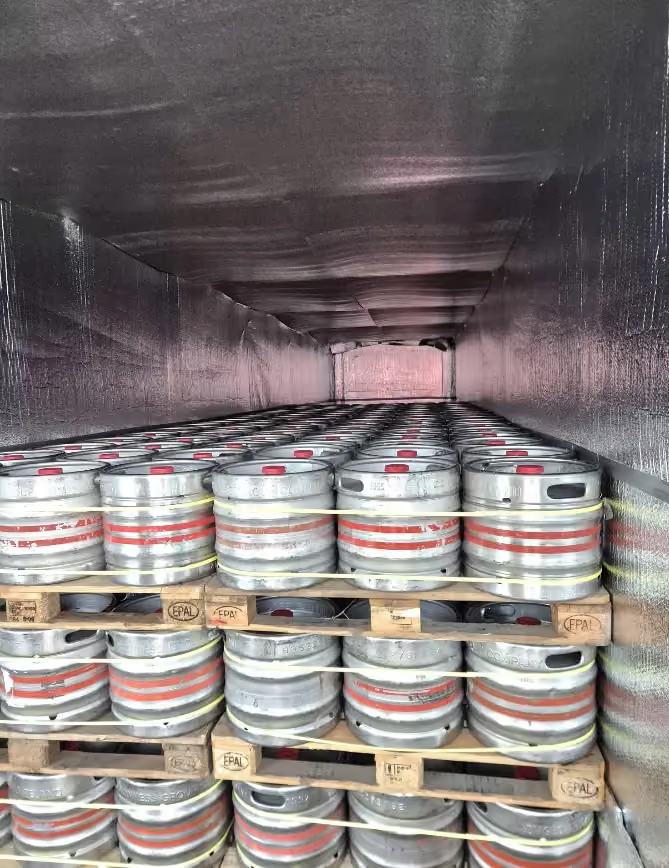
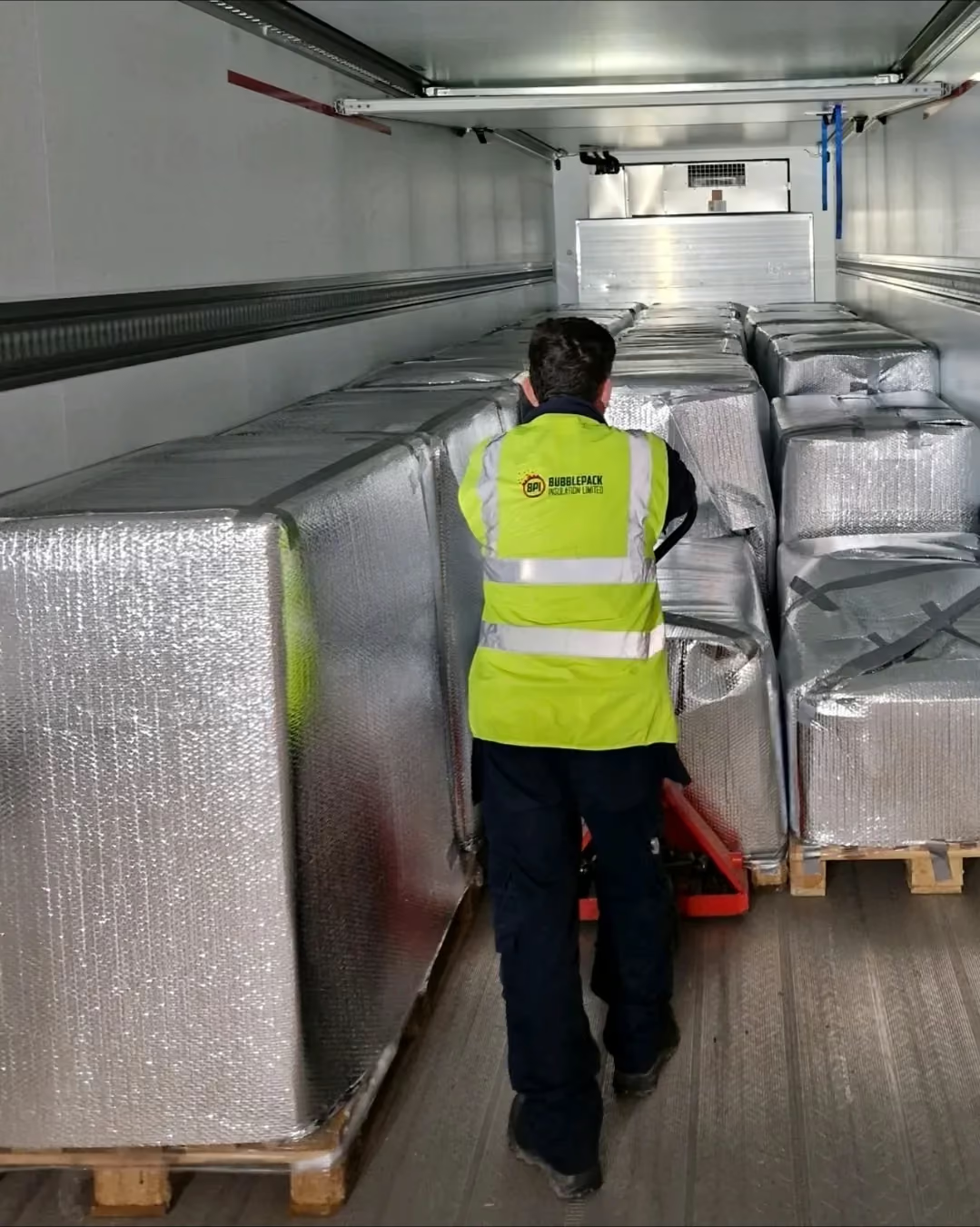
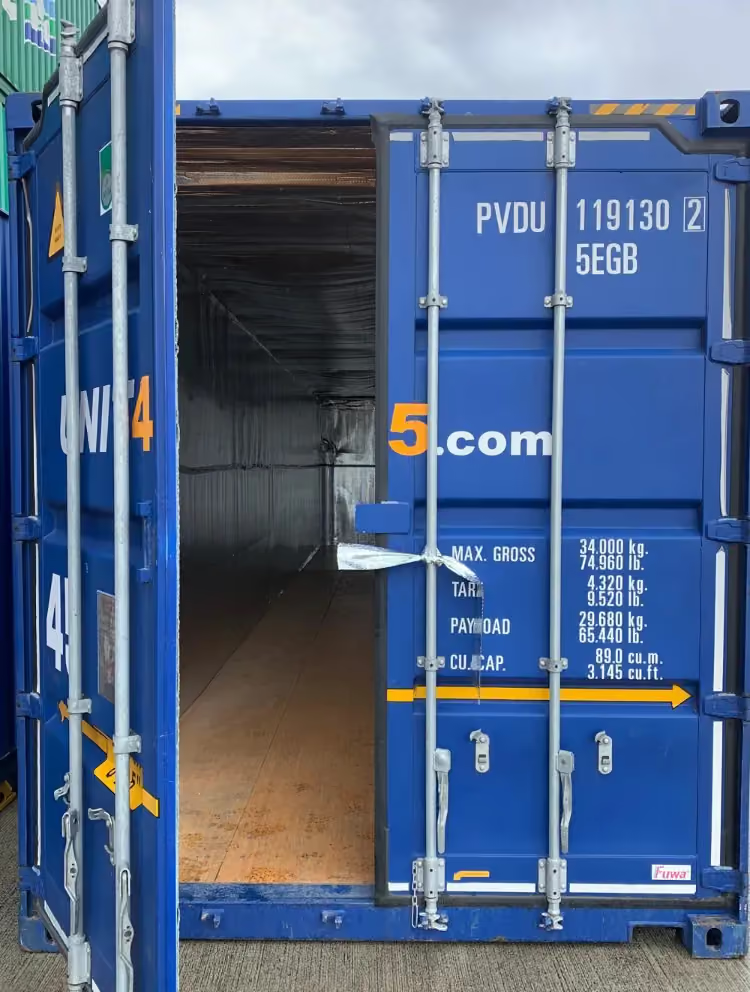
Whichever you choose, the liner is the same. Take supply and installation and the container arrives ready to load, with no change to your logistics workflow. Take liner supply and the Integrated Liner is prefabricated to fit standard 20ft, 40ft, 40ft HC and 45ft dimensions and fits in roughly 7 to 20 minutes (depending on container size) with minimal equipment and no specialist training. Tell us which suits your operation and we will quote it.
Supply and installation, delivered through our network of installation partners, so containers arrive ready to load with no change to your logistics workflow.
Liner supply for in-house fitting, with the Integrated Liner prefabricated to fit standard 20ft, 40ft, 40ft HC and 45ft dimensions.
Five-layer laminate, metallised polyester film bonded to high-density polyethylene woven fabric, EUROLAB tested, measured at 95 to 97 percent radiant heat reflectivity.
Measured water vapour transmission of 0.8 to 1.5 grams per square metre per 24 hours, so it functions as a moisture barrier and not only as thermal insulation.
Both apply across the EU and both are pushing exporters to re-examine whether a refrigerated container is genuinely necessary for cargo with a tolerance band.
The EU Emissions Trading System has applied to 100 percent of verified shipping emissions on voyages into and out of EU ports since 1 January 2026, up from 70 percent in 2025 and 40 percent in 2024. Because the cost scales with actual emissions, a method with a roughly 90 percent lower carbon footprint than a refrigerated container now carries a measurably lower ETS cost.
The revised EU F-Gas Regulation has restricted servicing with high global warming potential refrigerants since 2025 and is phasing out F-gases in new transport refrigeration systems, between 2027 for vans and ships and 2029 for trucks, trailers and reefer containers. A thermal liner uses no refrigerant at all, so none of the phase-down applies to it.
European container movements frequently involve transhipment, barge or rail onward legs and terminal dwell. Each additional overnight is another opportunity for the container interior to cool below the dew point of its own air and produce condensation, and cumulative thermal cycling causes more damage than a single peak temperature.
Rotterdam and Antwerp-Bruges are the two largest container ports in Europe, handling 14.245 million and 13.63 million TEU respectively in 2025, and between them more containers than the next five EU ports combined.
Together the top ten EU container ports moved 67 million TEU in 2025, up 3.1 percent year on year.
Terminal dwell and onward legs add unpowered standing time, where a passive liner keeps working and an unplugged reefer does not.
Consideration
Uninsulated dry container
Dry container with Integrated Liner
Refrigerated container
Protection during terminal dwell and transhipment
None
Continuous, no power required
Only while powered and plugged in
Cumulative thermal cycling on multi-leg routes
Full exposure, large swings
Narrower band, slower rate of change
Controlled, while powered
Moisture and condensation control
None
Measured vapour barrier of 0.8 to 1.5 g/m2/24hr
Refrigeration alone is not a moisture barrier
Who fits it
Not applicable
Our installation partner network, or your own team
Not applicable, equipment is hired
EU ETS emissions cost
Lowest emissions, no cargo protection
Roughly 90 percent lower footprint than refrigerated
Highest, fully within EU ETS scope since January 2026
EU F-Gas Regulation exposure
Not applicable
None, no refrigerant used
Applies, phase-down runs 2027 to 2029


Yes. Bubblepack supplies exporters and freight forwarders across Europe, with installation delivered through our network of installation partners where you would rather not fit liners yourself. Country-specific pages sit beneath this one as they are published.
The EU Emissions Trading System has applied to 100 percent of verified shipping emissions on voyages into and out of EU ports since 1 January 2026, up from 70 percent in 2025 and 40 percent in 2024. Because the cost scales with actual emissions, a shipping method with a roughly 90 percent lower carbon footprint than a refrigerated container carries a measurably lower ETS cost.
The revised EU F-Gas Regulation has restricted servicing with high global warming potential refrigerants since 2025 and is phasing out F-gases in new transport refrigeration systems, between 2027 for vans and ships and 2029 for trucks, trailers and reefer containers. A thermal liner uses no refrigerant at all, so none of the phase-down applies to it.
Rotterdam and Antwerp-Bruges are the two largest container ports in Europe. Rotterdam handled 14.245 million TEU in 2025 and Antwerp-Bruges 13.63 million TEU. Between them they handle more containers annually than the next five EU ports combined.
Yes. The liner is entirely passive with no power supply and no refrigerant, so protection continues through terminal dwell, barge and rail onward legs, and customs holds. A refrigerated container only maintains temperature while powered and plugged in.
Yes, and for repeat lanes it is usually the most practical arrangement. Because the Integrated Liner is a compact prefabricated unit rather than bulky rolls plus installation materials, it stores and draws down easily. Contact Bubblepack with your annual container volume to discuss stocking quantities.