
En
Bubblepack supplies thermal container liners to exporters and freight forwarders across Asia. Take supply and installation and the container arrives ready to load through our network of installation partners, or take liner supply and fit it with your own team.

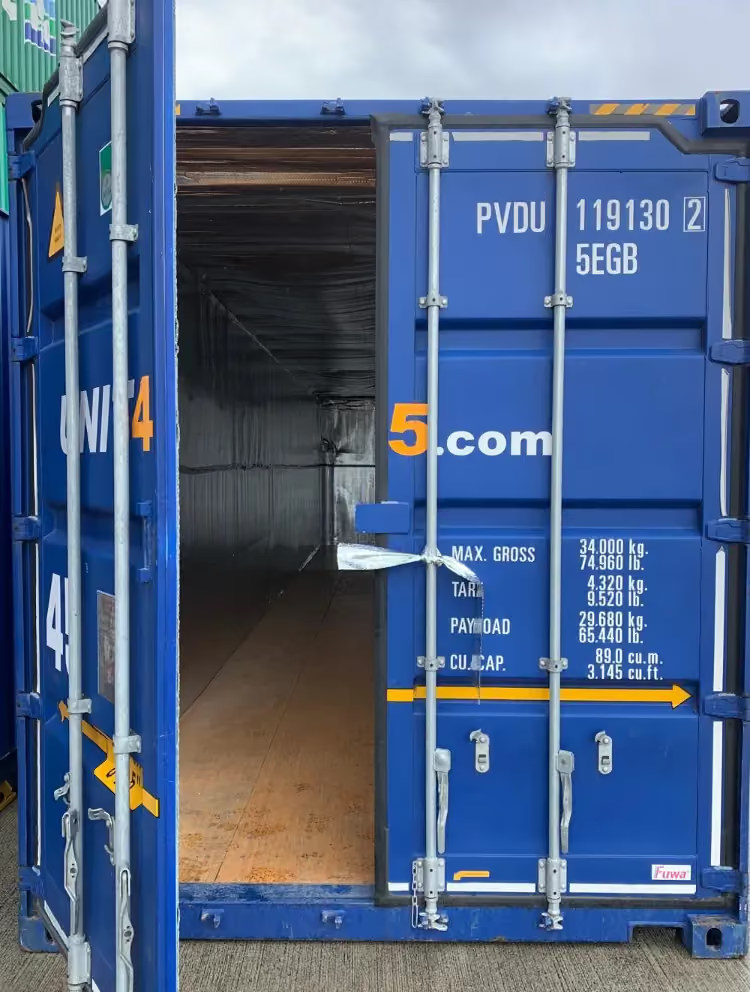
Tropical and long-haul Asian lanes combine the two conditions that damage cargo, sustained high ambient temperature and high humidity, over voyages long enough to produce many condensation cycles.
A container in direct sun can run 17 to 22 degrees Celsius hotter inside than the outside air, so a 30 degree tropical day can push the interior past 50 degrees.
Warmer air holds far more moisture. For roughly every 10 degree rise in temperature, air can hold about twice as much water vapour, so a humid tropical loading environment puts far more moisture inside the container before the doors close.
Long ocean transits mean twenty or thirty day-night cycles rather than one thermal event, and each cool-down is an opportunity for condensation to form on the roof and fall back onto the load.
Bubblepack has validated liner performance on a long-haul route from Ireland to the Middle East and Africa with a 40 degree upper parameter, using two loggers in one container, one inside the insulation and one outside.
.avif)
Whichever you choose, the liner is the same. Take supply and installation and the container arrives ready to load, with no change to your logistics workflow. Take liner supply and the Integrated Liner is prefabricated to fit standard 20ft, 40ft, 40ft HC and 45ft dimensions and fits in roughly 7 to 20 minutes (depending on container size) with minimal equipment and no specialist training. Tell us your loading location and annual volume and we will quote both.
Supply and installation, delivered through our network of installation partners, so containers arrive ready to load with no change to your logistics workflow.
Liner supply for in-house fitting, with the Integrated Liner prefabricated to fit standard 20ft, 40ft, 40ft HC and 45ft dimensions.
Compact prefabricated units, which matters more over long distances than it does within Europe, since they ship far more economically than rolls plus installation materials.
Five-layer laminate measured at 95 to 97 percent radiant heat reflectivity and EUROLAB tested, with water vapour transmission of 0.8 to 1.5 grams per square metre per 24 hours.
.avif)
This matters more in Asia than anywhere else in our coverage. Long transits, transhipment through major hubs and extended terminal dwell all create unpowered standing time, and a refrigerated container only holds temperature while it is plugged in.
A passive liner keeps working through terminal dwell, transhipment, customs holds and inland legs with no power supply at all.
There is no compressor to fail mid-voyage and no refrigerant to source or service at destination.
Exporters typically reduce shipping costs by 40 to 60 percent using thermal liners instead of refrigerated containers, depending on the route and product requirements.
Cross-checked against how competitors present the same comparison and against your own verified specification and Search Console data. Only figures confirmed in a real source appear here.
Consideration
Uninsulated dry container
Dry container with Integrated Liner
Refrigerated container
Peak temperature exposure on tropical lanes
Direct, interior can exceed 50 degrees
Reduced, radiant heat reflected before reaching cargo
Controlled to setpoint
Condensation risk over long transits
High, many cycles per voyage
Reduced, rate of temperature change dampened
Lower, but refrigeration alone is not a moisture barrier
Protection during transhipment and dwell
None
Continuous, no power required
Only while powered and plugged in
Mechanical failure risk mid-voyage
Not applicable
None, no moving parts
Compressor and refrigerant dependency
Shipping the protection itself to origin
Not applicable
Compact prefabricated unit, economical over distance
Equipment hired locally
Relative cost
Lowest, carries the damage risk
A fraction of refrigerated container cost
Highest, plus fuel and power
The table names a refrigerated container as the correct choice where it genuinely is. Buyers check that, and a page claiming a liner always wins loses credibility with the technical audience you want.


Yes. Bubblepack supplies exporters and freight forwarders across Asia, with installation delivered through our network of installation partners where you would rather not fit liners yourself. Country-specific pages sit beneath this one as they are published.
A container sitting in direct sun can run 17 to 22 degrees Celsius hotter inside than the outside air. On a 30 degree tropical day the interior can comfortably exceed 50 degrees, and steel surfaces under direct sunlight have been measured above 60 degrees. The hottest point inside is typically late afternoon or early evening rather than midday, because steel and cargo retain heat after solar input begins to fall.
Warm air holds far more water vapour than cool air, roughly doubling its capacity for every 10 degree rise in temperature. Loading in a humid tropical environment therefore puts far more moisture inside the container before the doors close. Every night at sea, the steel roof cools faster than the cargo, and once it drops below the dew point of the internal air that moisture condenses and falls back onto the load.
No. It is entirely passive, with no power supply, no refrigerant and no moving parts. That means protection continues through long transits, transhipment, terminal dwell and customs holds, and there is no compressor to fail mid-voyage. A refrigerated container only maintains temperature while it is powered and plugged in.
As a compact prefabricated unit. The Integrated Liner is manufactured to fit standard 20ft, 40ft, 40ft HC and 45ft dimensions and ships far more economically than rolls plus installation materials, which matters more over long distances than it does within Europe.
Exporters typically reduce shipping costs by 40 to 60 percent using thermal liners instead of refrigerated containers, depending on the route and the product requirements. On lanes where cargo has a genuine tolerance band rather than a strict single-degree requirement, that saving comes without a change in outcome at destination.