

It happens with both importers and exporters every day. The harsh truth is that most cargo insurance policies do not cover condensation damage, and most shippers never know this until it is too late. But be aware of these things before because you deserve a clear, honest answer to why this happens and what you can do about it. In this information, I will explain these points in detail.
What Is Condensation Damage, and Why Does It Keep Happening?
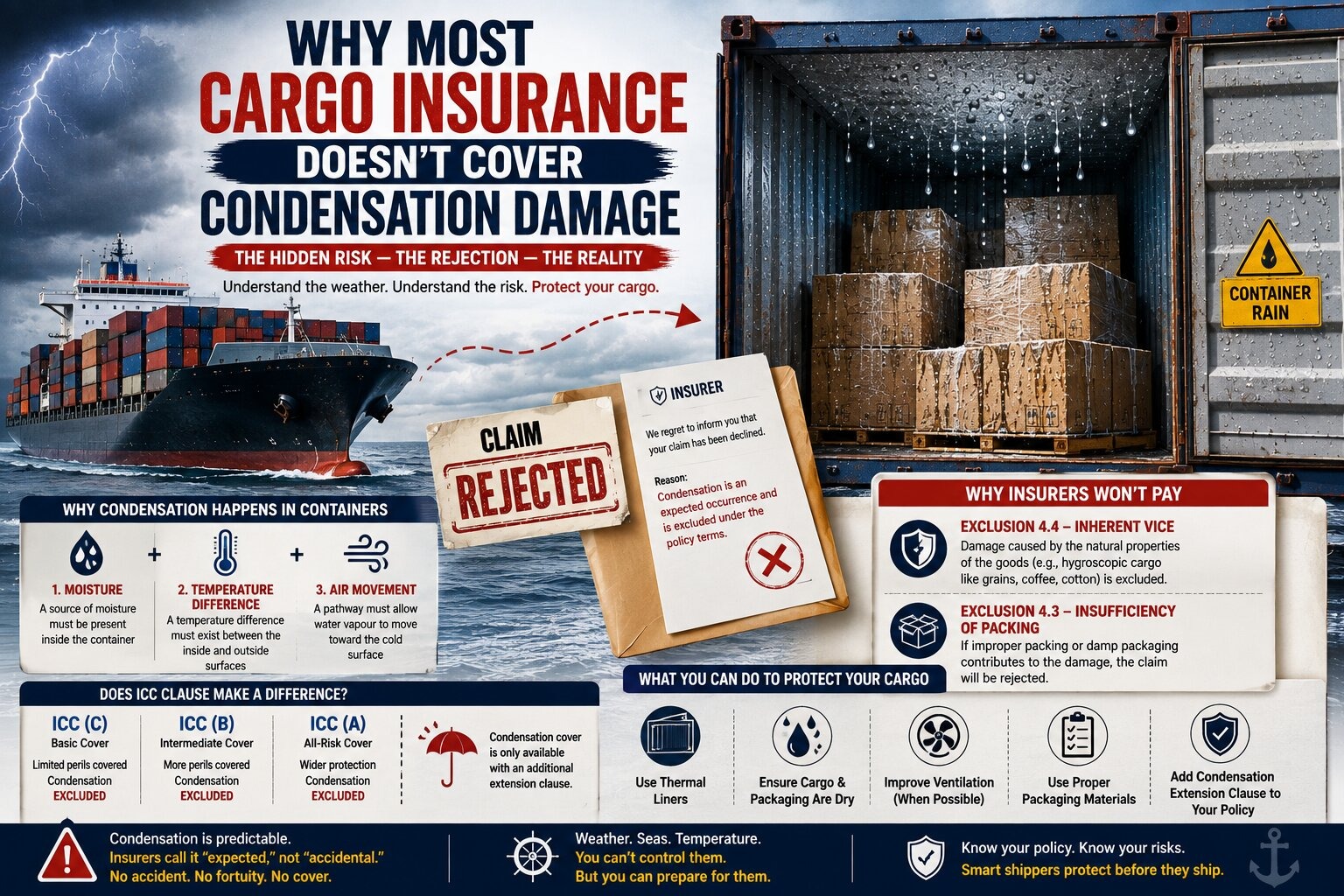
Condensation inside a shipping container is exactly what it sounds like. Warm, moist air meets a cold steel surface. Water droplets form on the walls and ceiling. Then they drip directly onto your cargo. The industry calls it "container rain" when it falls from the roof, and "cargo sweat" when moisture forms on the goods themselves.
It doesn’t matter what you are shipping. Like Crude oil and fuels, Clothing and textiles, Vehicles or auto parts, and Furniture or building materials, Coffee beans, steel coils, electronics, food products and perishables, all of these items are at risk. There are 3 conditions that exist at the same time for condensation to happen:
- A source of moisture must be present inside the container
- A temperature difference must exist between the inside and outside surfaces
- A pathway must allow water vapour to move toward the cold surface
The moisture comes from many places like absorbent packaging materials, ambient air, damp stored goods and wet timber pallets are one of the biggest culprits. The cargo itself releases moisture too, especially hygroscopic goods like grains, coffee, and cotton. Even the air trapped at loading time carries humidity. As the vessel moves through different climatic zones, from tropical waters near the equator to cooler northern seas, temperatures rise and fall, and condensation is almost guaranteed to occur at some point.
Why Your All-Risk Policy Is Not as "All" as You Think
When you received the container, you opened it. The goods are soaked. Mould has spread across the packaging. You paid for All-Risk cargo insurance, so in this situation you file a claim. Then your insurer sends back a rejection letter.
Most cargo is shipped under Institute Cargo Clauses (A), commonly known as ICC(A) or All-Risk cover. The name sounds comprehensive. It is not.
"All Risk" in marine insurance does not mean every type of damage is covered. It means only fortuitous losses are covered. A fortuitous loss only happens when it have an accident, something unexpected, something you could not reasonably have predicted or prevented.
Insurers classify condensation as a known and expected event. It is not an accident. It is a natural physical process that occurs in virtually every sealed steel container on a long sea voyage. Because it is predictable, insurers argue it is not fortuitous. No fortuity means no cover.
According to the International Institute of Marine Surveyors, condensation in containers is considered an expected risk of the shipping process, not an insured peril.
The Legal Words That Kill Your Claim: Inherent Vice and Fortuitous Loss
When your claim is rejected, the rejection letter usually refers to two specific clauses inside the Institute Cargo Clauses:
Exclusion 4.4 — Inherent Vice: Insurers use this clause to deny claims when the damage is caused by the natural properties of the goods themselves. Hygroscopic cargo, products that naturally absorb and release moisture, falls squarely into this category. Coffee beans sweat. Grains breathe. Cotton absorbs humidity. The insurer says the cargo caused its own damage.
Exclusion 4.3 — Insufficiency of Packing: If damp timber pallets or insufficiently dried packaging contributed to the condensation, insurers apply this exclusion. The argument is that the shipper failed to pack the goods properly for the journey.
Even if your cargo is not hygroscopic, say you are shipping steel components or consumer electronics, the rejection still stands. Insurers argue that condensation inside any sealed container is an expected occurrence, not an accident. Your policy only pays for accidents.
Which ICC Clause Are You On and Does It Even Matter for Condensation?
You might wonder whether upgrading from ICC(C) to ICC(B) or ICC(A) would solve the problem. The answer is no, at least not on its own.
All three levels of cover use the same exclusions. Inherent vice and insufficiency of packing are excluded under ICC(A), ICC(B), and ICC(C) alike. The higher you go in cover, the broader the protection against external perils like fire, collision & general average, but condensation remains excluded at every level.
The only way to get condensation cover is to ask your broker to add it explicitly as a separate extension clause. It exists. But most standard policies do not include it automatically.
The Volcafe Case: Did the Law Just Change in Your Favour?
In 2018, the UK Supreme Court ruled on Volcafe Ltd v Compania Sud Americana De Vapores SA (CSAV). It became one of the most important cargo law decisions in decades.
Volcafe shipped nine consignments of green coffee beans from Colombia to Germany. The carrier prepared and loaded the containers. On arrival in Bremen, 18 out of 20 containers were found damaged by condensation. The cargo owners sued the carrier.
The court ruled that carriers have a duty to deliver goods safely. If a carrier wants to rely on the "inherent vice" defence under the Hague Rules, they must prove they took every reasonable precaution to prevent the loss. CSAV had used unventilated containers and insufficient Kraft paper lining. They could not meet that standard. They lost.
So now the question is: does the Volcafe ruling mean you can now claim against the carrier instead of your insurer?
The answer is possibly, but only when the carrier prepared and loaded the container. In most shipments, the shipper packs the container themselves. In that scenario, the carrier can point the responsibility back at you. The Volcafe ruling is powerful, but it is not a blanket solution for every condensation loss.
Can You Actually Buy Condensation Cover? Here Is What It Costs
Yes, you can. Some insurers offer a condensation extension clause, though it rarely comes automatically. You must request it, and you should expect:
- An additional premium of up to 0.25% of the insured value
- A higher excess or deductible — often USD 10,000 or 7410 pounds or more per claim
- Strict conditions around how the cargo is packed, palletised, and documented
The clause commonly used reads: "Cover hereunder includes loss of or damage to the subject-matter insured howsoever arising from condensation and/or sweating and/or heating and/or humidity and/or frost."
You need to ask your broker for this clause by name. Do not assume your All-Risk policy includes it.
Five Things You Must Do Before the Shipment Leaves the Port
Prevention is your strongest defence, both against actual damage and against a rejected claim. You should must take these steps before sending every shipment:
- Use only kiln-dried timber pallets with a moisture content below 20%
- Load containers in a covered, dry environment where possible
- Place moisture-absorbing desiccant bags inside the container, the number depends on cargo volume and voyage length
- Line the container interior with Kraft paper or a thermal liner to regulate temperature and reduce condensation build-up
- Document every single thing: moisture readings, packing procedures, container condition at loading, and desiccant placement
That last point matters more than most shippers realise. Your documentation is your main evidence. Without it, even a valid claim becomes difficult to prove.
Your Claim Got Rejected. What Do You Do Now?
Do not accept the rejection easily as the final word. You have only these options.
First, request the full written grounds for rejection. Ask the insurer to specify exactly which exclusion clause applies and why. A claims handler who cannot clearly point to an exclusion clause is a sign the rejection may be challengeable.
Second, check whether the carrier might be liable. If the carrier arranged container preparation or loading, the Volcafe principle may apply. Consult a marine solicitor before signing any settlement or waiver.
3rd, review your documentation. If you have moisture readings, packing records, and evidence of desiccants used, you are in a stronger position than a shipper with no records at all.
4th, speak to an independent marine surveyor. The International Union of Marine Insurance (IUMI) is a useful starting point for understanding your rights and finding qualified surveyors.
How to Talk to Your Broker So You Never Get Caught Off Guard Again
Your insurance broker has a duty to place cover that meets your actual needs. You should ask them two direct questions before your next shipment:
Does my current policy include condensation cover?
If the answer is yes, ask to see the exact clause wording. If the answer is no, ask what it would cost to add it.
Am I covered if the cargo damages itself due to its own moisture content?
This pins down the inherent vice question directly.
You should also tell your broker the exact nature of your cargo, the voyage route, and your usual packing method. Routes that cross the tropics carry a higher condensation risk. Voyages from hot, humid origins, such as Central America, South-East Asia, or West Africa, to cooler destinations in Northern Europe are particularly high-risk. Your broker needs that information to place the right cover.
The cost of a condensation claim runs into tens of thousands. The cost of the right clause is a fraction of that. Ask the question before the shipment, not after the container doors are opened.
How can Bubble Pack help you?
As I told you before, there are so many problems that occur when you are sending the shipment. You can save your items with the help of thermal container liner insulation, like the fitted container liners offered by BubblePack Insulation, which creates a temperature buffer between the steel container walls and your cargo. It reduces the severity of temperature swings that cause condensation, and it gives you a defensible argument that you took reasonable precautions, which is exactly what insurers and carriers look for.
.jpg)
.jpg)