
Container Sweat vs Cargo Sweat: Which One Is Ruining Your Shipment?
You put the products in the container. You seal the container. You load clean, dry goods. You close the doors. But when the shipment arrives, your cargo is wet, mouldy, or corroded. No leak. No rain. No visible damage to the box.
Two separate phenomena cause this. They share a name, they share a physics, and they are almost always confused. One attacks your cargo from above. The other attacks it from the surface out. You cannot fix the right problem until you know which one you are facing.
Why Two Drops of Water Can Mean Two Completely Different Problems
Imagine a cold glass of water on a summer's day. You did not pour anything on the outside. Yet the surface is wet. That is exactly what cargo sweat does to a cold shipment entering a warm port.
Now imagine the container ceiling dripping onto your cartons at 3 a.m. in the North Atlantic. The steel cooled. The warm, humid air inside hit its dew point. The water fell. That is container sweat.
Both are condensation. Both come from the same law of physics. Yet they form on opposite surfaces, and they destroy different things in different ways.
What Is Container Sweat? (And Why It Rains Inside a Sealed Box)
Container sweat happens when warm, damp air inside a metal box cools down and hits its dew point against the cold steel on the outside. This causes condensation to form on the inside walls and top of the box.
You load warm, humid air into a sealed steel box at a tropical port. The ship sails north or into cold ocean air at night. The steel cools fast, because steel conducts heat rapidly. The air inside stays warmer for longer. That warm air holds moisture. Then the steel surface drops below the air's dew point, and water condenses directly onto the container ceiling.
It builds. It drips. It falls onto your cargo from above.
The dew point is the trigger. At 30°C and 80% relative humidity, the dew point sits at roughly 26°C. A night-time cooling of just four degrees is enough to start the drip. Across a 28-day ocean voyage, that cycle repeats dozens of times.
Container sweat is most common on warm-to-cold routes, departures from West Africa, Southeast Asia, or the Middle East heading to Northern Europe or Canada.
According to industry data, approximately 1 in 5 ocean shipments suffers some form of condensation damage in transit. A significant share of those claims are never correctly attributed to container sweat vs cargo sweat at the point of inspection.
What Is Cargo Sweat? (And Why Your Cold Goods Become a Wet Sponge)
Cargo sweat is a type of condensation that forms on the surface of goods being shipped when they are put in warmer, more humid air.
For example, you load cold goods, chilled dairy powder from an Irish depot in January. The container departs for the Middle East or Southeast Asia. You open the doors at the warm, humid destination port. Warm, moisture-laden air rushes in and meets the cold surface of your goods.
The air cannot hold its moisture at that contact point. It drops it. Directly onto your product, your packaging, and your labels.
No drip from above. No wet ceiling. The damage is surface-level, immediate, and sometimes catastrophic.
Cargo sweat is most common on cold-to-warm routes, goods loaded in Ireland, the UK, or Northern Europe like Denmark, Finland, Iceland, Norway, and Sweden. Destined for tropical or sub-tropical markets. It also happens mid-voyage when a container crosses climate zones and the cargo stays colder than the surrounding air for extended periods.
What Does Each Type of Sweat Destroy First?
The damage tells you which type you faced.
Container sweat hits:
- Carton tops and upper layers first, wet patches from above
- Labels peel or bleed from drip contact
- Mould forms on the outer packaging layer
- Metal goods corrode at the highest points where drips land
Cargo sweat hits:
- The product surface directly, before packaging is affected
- Powder products cake and clump at the surface
- Metal goods rust uniformly across exposed faces, not just at the top
- Pharmaceutical coatings and labels absorb moisture from contact, not drip
You should check where the moisture appears first. Damage from the top down points to container sweat. Damage across the product surface points to cargo sweat.
Which Routes Trigger Container Sweat, and Which Ones Trigger Cargo Sweat?
Irish exporters shipping dairy, pharma, or beverage products to warm markets face cargo sweat risk almost every voyage. Importers receiving goods from warm origins face container sweat risk at the unloading stage.
You can read more about container rain and how condensation forms inside a sealed container in Bubblepack's detailed guide: What Is Container Rain? Causes and How to Stop It.
Can One Shipment Suffer Both at the Same Time?
Yes, and this is the gap no competitor explains.
A long transatlantic voyage or a route from Ireland to Southeast Asia crosses multiple climate zones. Your cold goods may cause cargo sweat at the warm destination port. But during the cold mid-ocean leg, the container ceiling may drip from container sweat onto the top layer of cartons.
You arrive with damage from two directions. The top cartons are wet from drip. The product surface on the outer layer has surface condensation. A standard insurance inspection often misattributes both to a single cause, and the wrong fix gets applied next time.
You need to protect against both mechanisms on any voyage that crosses more than one climate zone.
How Do You Tell Which One Hit Your Cargo After the Damage Is Done?
You should check three things at the point of inspection.
Location of moisture: Moisture concentrated on the upper layers and carton tops points to container sweat. Moisture distributed evenly across exposed surfaces, including on the product itself, points to cargo sweat.
The ceiling and walls: A wet container ceiling with dried salt-like residue confirms container sweat occurred. A dry ceiling with wet goods confirms cargo sweat.
Damage pattern on metal goods: Rust that starts at the highest points and runs downward indicates drip from above. Rust that covers flat, horizontal surfaces uniformly indicates surface condensation from cargo sweat.
What Stops Container Sweat vs What Stops Cargo Sweat?
Both need the dew point controlled. But the methods are weighted differently.
To stop container sweat:
- Load dry, never seal warm, humid air into the container at origin
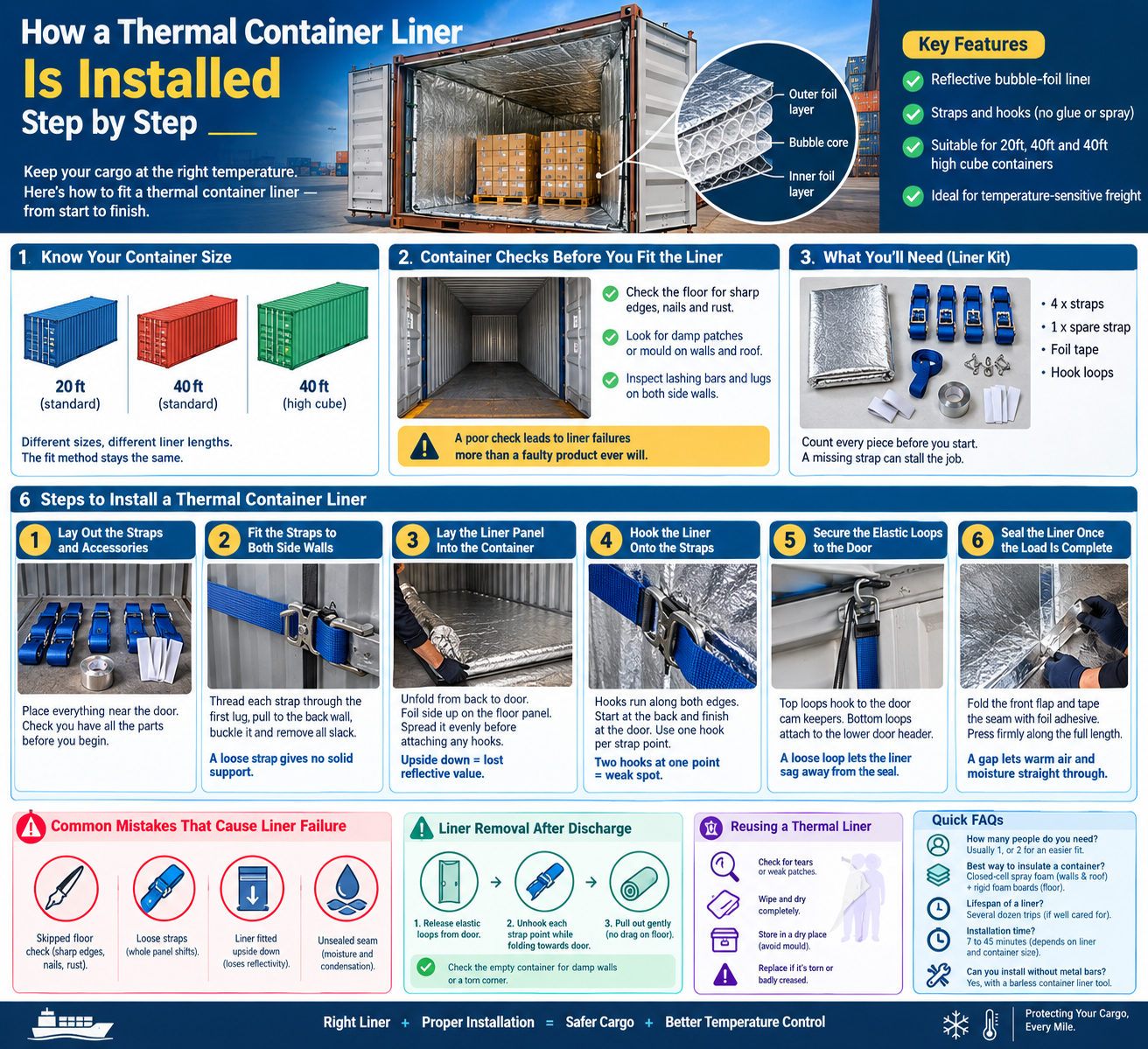
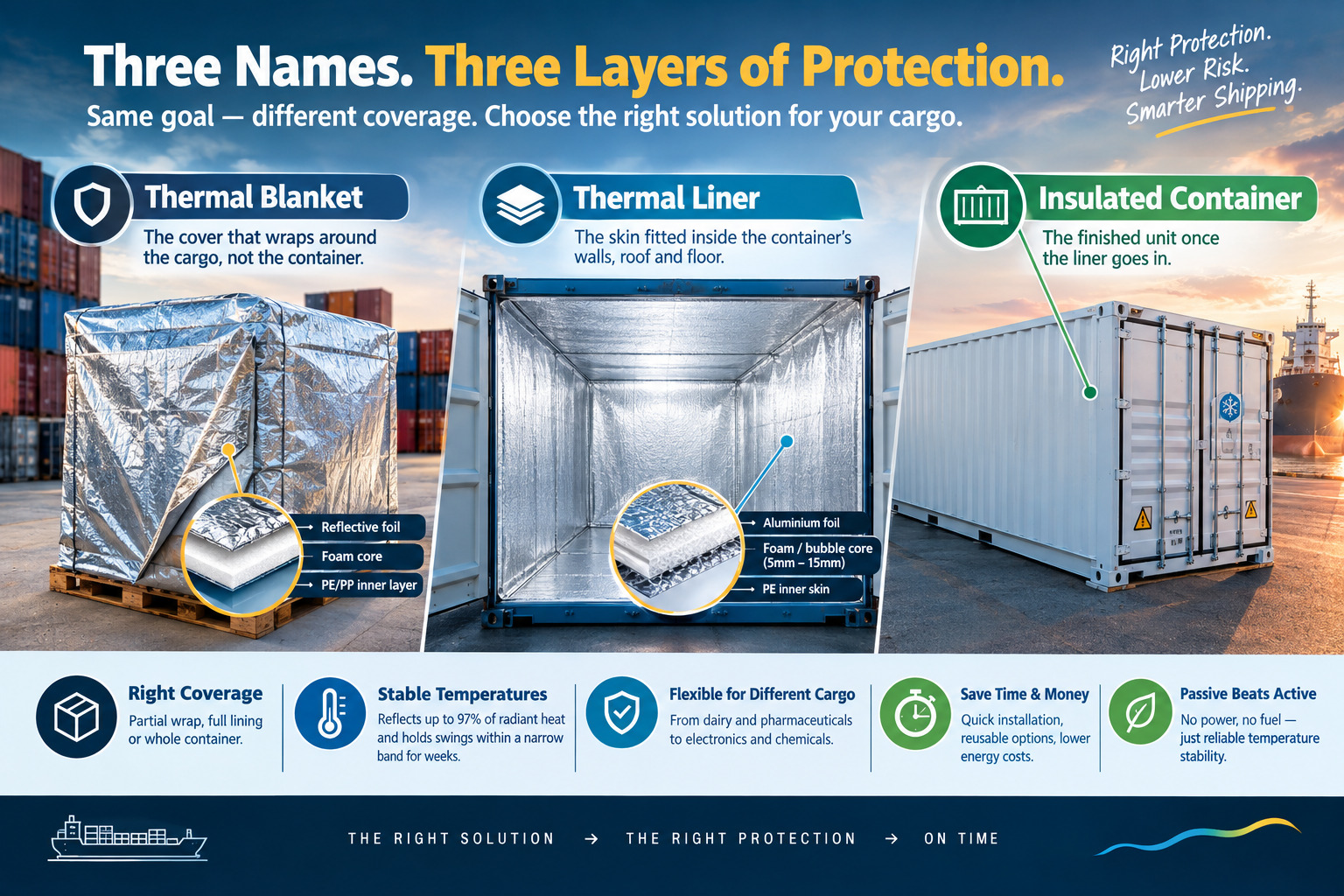
- Use a thermal container liner to reduce the rate at which the steel wall cools, slowing the temperature drop that triggers condensation
- Use high-capacity container desiccants to absorb moisture from the enclosed air
- Avoid ventilation on cold sea legs, it pulls in cold air and accelerates the steel cooling
To stop cargo sweat:
- Bring cargo up to ambient temperature before loading where possible
- Use an insulated thermal container liner to buffer the temperature difference between cold goods and warm outside air, the liner slows the warm air's access to the cold cargo surface
- Use desiccants inside the liner to absorb any moisture that forms at the boundary
- Keep container doors closed at warm, humid destination ports until cargo reaches ambient temperature
A professionally installed thermal container liner addresses both mechanisms. It reduces the rate of heat transfer through the steel wall, which reduces container sweat. It also buffers the cold cargo from warm outside air, which reduces cargo sweat. Desiccants handle residual moisture that the liner does not fully contain.
The One Number That Decides Everything: Your Dew Point
The dew point is the temperature at which air releases its moisture as liquid water. You do not need a formula. You need the rule.
If the container steel or cargo surface drops below the dew point of the surrounding air, condensation starts. Full stop.
At 25°C or 75% relative humidity, usually for West Africa or Southeast Asia, the dew point is approximately 20°C. A steel container wall cooled by cold sea air can drop to 15°C within hours. That is a 5°C gap below the dew point. The ceiling starts dripping.
At an Irish depot in February, goods loaded at 5°C arrive in Singapore where the dew point is 27°C. The cold cargo surface is 22°C below the dew point of the air. Cargo sweat is instant and severe.
You should calculate the dew point difference for your specific route before each shipment. Your departure temperature and humidity, your destination temperature and humidity, and the mid-voyage climate zone all feed into the calculation
Which Cargo Types Face the Most Risk?
Knowing which sweat type you face is the first decision in your protection plan. The second is choosing the right combination of tools and applying them in the right order. A thermal container liner reduces the temperature differential that triggers both mechanisms. Desiccants handle the residual moisture. Load temperature management is the factor most exporters miss.
Get the protection right before you seal the doors. The damage shows up weeks later, at the destination, and by then, the shipment is your problem.