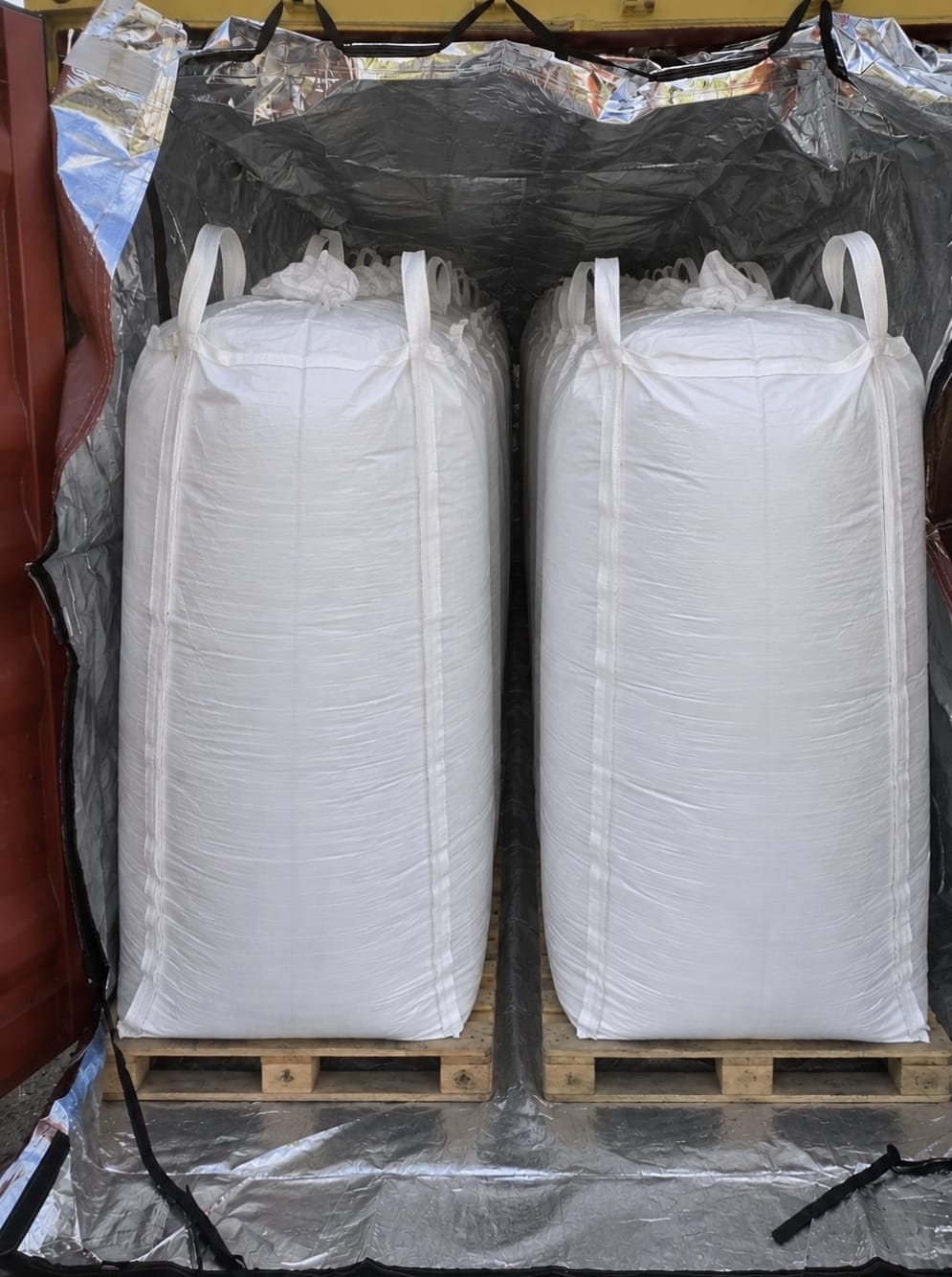

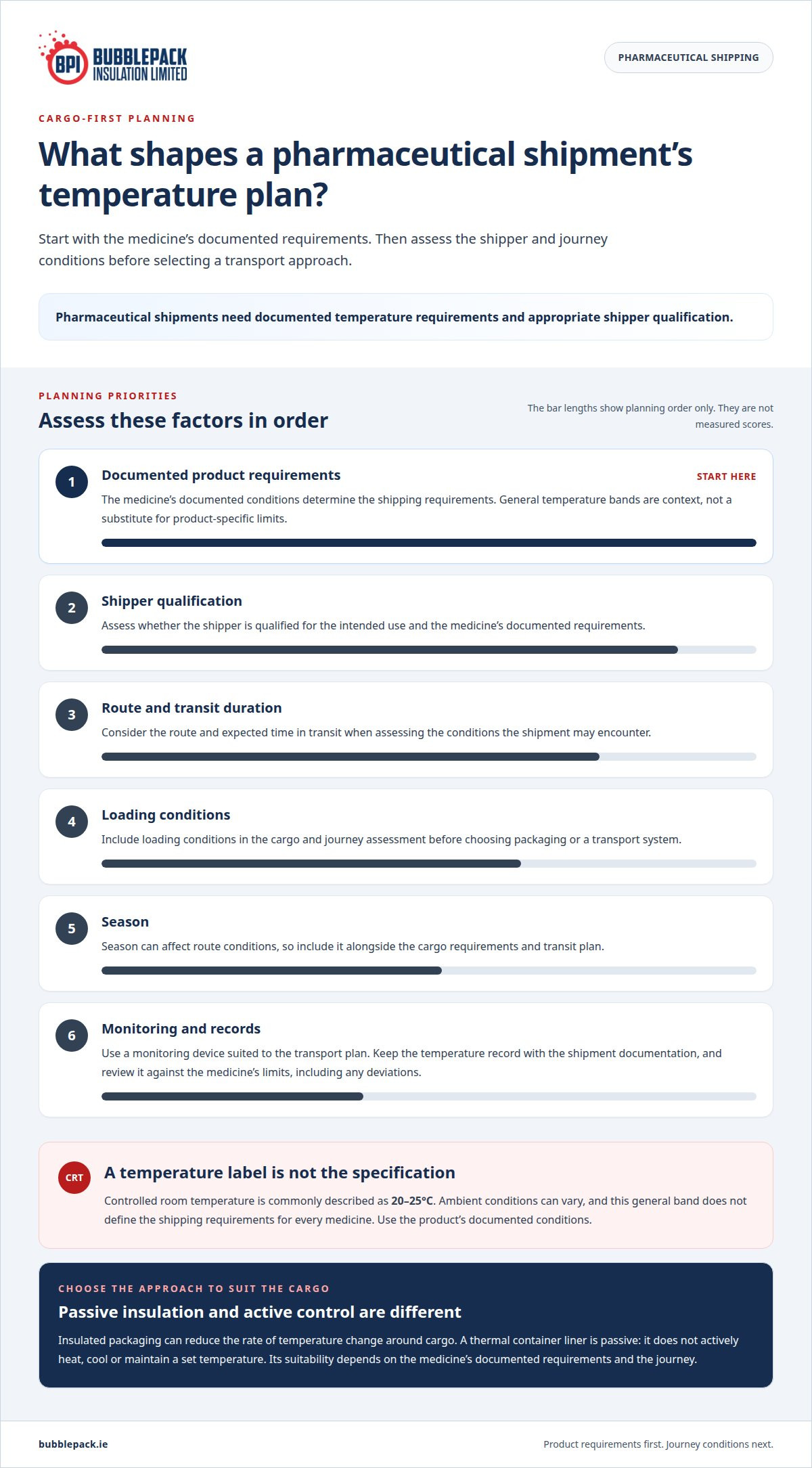
A room-temperature label is not a universal shipping range. The ambient pharmaceutical shipping temperature range for controlled room temperature (CRT) is commonly described as 20-25°C, while ambient ranges can vary; the medicine’s documented temperature requirements determine the conditions its shipment must meet. General temperature bands are a starting point, not a substitute for product-specific requirements.
That distinction matters because conditions can change along a route, and passive insulation cannot actively maintain a set temperature. Pharmaceutical shipments need documented temperature requirements and appropriate shipper qualification, with protection matched to the cargo and journey.
This article explains ambient shipping, how CRT differs from chilled and frozen transport, and the factors that shape a suitable shipping approach. It also covers how passive thermal container liners can contribute to cargo protection, and when active temperature control may be more appropriate.
Key Takeaways
• Distinguish ambient transit from controlled room temperature handling, and treat general temperature bands as context rather than a medicine’s shipping specification.
• Use the product’s documented temperature requirements and appropriate shipper qualification to guide pharmaceutical transport planning.
• Compare CRT, chilled and frozen handling against the medicine’s actual requirements before selecting a shipping approach.
• Consider the BPI ROLL LINER for passive container insulation where it suits the cargo and route; it does not actively control temperature.
What is Ambient Shipping?
Ambient shipping exposes cargo to surrounding conditions, while controlled room temperature (CRT) shipping manages the internal environment. For medicines, the product’s documented requirements, not a general temperature band, determine the shipping conditions.
Ambient and Controlled Room Temperature Shipping
Ambient shipping means packaged goods may be exposed to the surrounding temperature along the route. Location, season and time can all affect those conditions, so the term alone does not define one temperature range for every shipment.
CRT shipping aims to keep the internal environment controlled, reducing reliance on outside conditions. The ambient pharmaceutical shipping temperature range for CRT is commonly described as 20-25°C, but that band is context, not a universal medicine specification. Check the product’s documented limits and the transport conditions it requires.
CRT Pharmaceutical Shipments
For pharmaceutical transport, CRT describes a controlled internal temperature approach rather than exposure to unregulated surroundings. USP defines controlled room temperature as 20°C to 25°C. Ambient storage is generally described as 15°C to 30°C, illustrating why “ambient” and “CRT” should not be treated as interchangeable terms.
Temperature-controlled shippers are designed to manage conditions inside the shipping system despite external variation. Their suitability depends on the medicine’s documented requirements, route and transit conditions. EU GDP guidance requires transport conditions to remain within the limits defined by the manufacturer or stated on the outer packaging.
CRT Temperature Monitoring and Records
Monitor shipment temperatures using a device suited to the transport plan, and retain its records with the shipment documentation. Review the recorded profile against the medicine’s documented limits, including any deviations, so the responsible pharmaceutical business can assess the shipment.
Keep product requirements, monitoring results and any deviation assessment together in the transport record. This supports traceability across handovers and helps show how the shipment was handled. Pharmaceutical shipments need documented temperature requirements and appropriate shipper qualification.
Temperature-sensitive pharmaceutical and biologic materials
Pharmaceuticals and biologics can be sensitive to temperature fluctuations, but requirements vary by product. Medical devices, clinical trial materials, diagnostic kits, and blood and tissue products may also need temperature-conscious transport. Start with the medicine’s documented conditions, then assess the route, loading conditions, season and transit duration. A general CRT label cannot replace product-specific shipping requirements.
Choose packaging based on that assessment. Insulated packaging can reduce the rate of temperature change around cargo, while a temperature-controlled shipper may use refrigeration or heating. These approaches are not interchangeable: the required internal conditions and expected journey determine which system is suitable. Pharmaceutical shipments also need documented temperature requirements and appropriate shipper qualification.
Refrigerants and phase-change materials
Refrigerants absorb or release heat as they change state, helping packaging manage its internal conditions. Traditional passive pharmaceutical shippers use water-based refrigerants that change phase at 0°C. That behaviour matters: a cooling element selected without regard to the product’s limits can expose sensitive cargo to unsuitable conditions. Packaging design must account for the refrigerant’s temperature behaviour and placement.
Phase-change materials (PCMs) change between solid and liquid states at a specific temperature. Some CRT packaging designs use a 22°C PCM in liquid form. This example describes a packaging design, not a universal CRT target or a specification for every medicine. Match the PCM transition point to the product’s documented requirements and the intended shipping system.
Match the system to the cargo
Before selecting packaging, compare the medicine’s stated temperature limits with the route and expected transit duration. Then assess loading conditions and whether the shipper is qualified for that use. A PCM or refrigerant can support temperature management, but does not by itself establish that a shipment meets its requirements.
For example, a biologic and a diagnostic kit may have different handling requirements, even though both are temperature-sensitive. Record the product conditions and the chosen system’s role in the transport plan. This ties the packaging decision to the actual cargo, rather than a broad category such as “pharmaceuticals”.
CRT and cold-chain temperature ranges
CRT and cold-chain handling describe different temperature conditions, not interchangeable shipping labels. A commonly cited CRT band is 20°C to 25°C. For a particular medicine, its documented product conditions remain the shipping requirement. Stability information and the manufacturer’s instructions guide the responsible pharmaceutical business when it selects transport conditions.
Cold-chain products require chilled or frozen handling rather than a general room-temperature approach. WHO guidance describes cool storage for medicines as 8°C to 15°C, while frozen products may be transported within a cold chain and stored at -20°C. These reference bands help explain terminology; they do not establish the conditions for every medicine.
Other definitions show why labels need precision. The USP defines cold as any temperature not exceeding 8°C, warm as 30°C to 40°C, and excessive heat as above 40°C. The EMA guideline says products tested at 5°C ± 3°C should be labelled for refrigerator storage or refrigerated storage and transport. Those terms describe distinct conditions, so a CRT product should not be assigned a chilled range by assumption.
For a shipment decision, compare the product’s stated limits with the transport plan. Record whether it requires CRT, refrigeration or frozen handling, then align packaging and monitoring with that requirement. This avoids treating a broad term such as “cold chain” as a complete specification. The shipment’s documented limits, not the category name alone, determine whether conditions are suitable.
Regulatory planning goes beyond choosing a temperature band. EU GDP compliance involves documented transport processes, product requirements, risk assessment and appropriate qualification by the responsible pharmaceutical business. Keep the rationale for the selected shipping conditions with the transport records, including how stability requirements informed the decision. A label stating a defined temperature range gives logistics teams clearer instructions than terms such as “ambient” or “room temperature” alone.
Ambient shipping temperature range
Ambient shipping does not have one temperature range that applies to every pharmaceutical product. Examples used for ambient conditions include 15-25°C and 0-40°C, but these describe different possible ranges, not interchangeable shipping specifications. A medicine’s documented conditions determine the acceptable range. The practical task is to translate those limits into handling and monitoring arrangements for the actual route.
Ambient conditions can change with location, season and time. A consignment may face different exposures during loading, port handling and transit. Assess the route as a sequence of handling stages, rather than assuming one steady environment throughout. This helps identify where temperature monitoring and suitable packaging need to support product integrity.
FDA rules do not establish one universal CRT shipping range for all pharmaceutical products. The medicine’s documented requirements should therefore guide the transport plan, rather than a general ambient label or a range borrowed from another product.
For planning, record the product’s stated limits and identify route conditions that could affect the cargo. Consider loading conditions, seasonal exposure and transit duration together. Then specify how temperatures will be monitored and how records will be reviewed. This makes the operating plan specific to the shipment, rather than relying on the word “ambient” alone.
The European Commission’s Guidelines on Good Distribution Practice of medicinal products for human use address transport conditions and medicinal-product requirements. Refer to the guidance when documenting how the transport plan accounts for the product’s stated conditions. The responsible pharmaceutical business should connect that assessment to its own documented processes and shipper qualification.
Passive insulation can moderate the effects of external temperature changes, but it does not actively heat, cool or maintain a setpoint. If a product requires active temperature control, the transport method must provide it. Base the decision on product requirements and the shipment’s route, loading conditions, season and duration.
BubblePack Insulation: BPI ROLL LINER
BPI ROLL LINER provides passive thermal insulation for shipping containers, helping moderate the effects of external temperature changes during transit. Its reflective thermal barrier system does not actively heat, cool or maintain a setpoint. Pharmaceutical suitability therefore depends on documented product requirements, loading conditions, route, season and transit duration.
BubblePack Insulation Ltd supplies and professionally installs the liner across Ireland. For a pharmaceutical shipment, treat it as part of the cargo-protection plan, not as a substitute for appropriate shipper qualification or temperature monitoring. Plan the container type, depot location, collection date, cargo requirements and liner installation around the shipment.
Where active temperature control is required, a thermal liner alone is not the appropriate control system. Contact BubblePack Insulation Ltd to discuss container insulation for a planned export shipment.
Plan the next shipment with its requirements in view
Use the ambient pharmaceutical shipping temperature range for CRT as a planning reference, not as a substitute for product-specific instructions. The next step is to turn those instructions into a practical shipment plan, with clear responsibilities for cargo preparation, monitoring and record review. This keeps logistics decisions connected to the medicine’s requirements throughout the journey.
For containerised exports, consider how passive insulation may fit into the wider protection plan, alongside the route, loading conditions and transit duration. The right approach depends on how these factors align with the cargo’s documented requirements. Keep that assessment central when considering container protection.
BubblePack Insulation can discuss thermal liner options for suitable export applications. Contact BubblePack Insulation to discuss your shipment and the cargo-protection requirements you’re working to meet. A clear conversation about the transport plan can help you identify the relevant next step for your operation.
Frequently Asked Questions
What does CRT mean for pharmaceutical shipping?
CRT means controlled room temperature: transport is planned to keep the medicine within its specified room-temperature conditions. The abbreviation does not establish one suitable range for every product. Two medicines labelled for room-temperature storage, for example, may have different documented limits. Use the product’s requirements to define the shipment plan, and retain monitoring records showing how the consignment was handled.
What is the standard controlled room temperature (CRT) range for pharmaceutical shipping in the US?
The USP controlled room temperature range is 20°C to 25°C, equivalent to 68°F to 77°F. Treat this as a general definition, not an automatic shipping specification for every medicine. Check the product’s labelling and documented requirements, then plan the transport conditions accordingly. A shipment’s acceptable range comes from its product-specific requirements, rather than from the CRT abbreviation alone.
What are the USP controlled room temperature storage limits in °F and °C?
USP controlled room temperature is 20°C to 25°C, or 68°F to 77°F. The stated storage allowance also describes fluctuations of ±2.5°C. These figures define CRT storage context; they do not replace the medicine’s own documented conditions. For operational records, use one consistent temperature scale and ensure the shipment assessment compares readings against the product’s applicable limits.
What temperature excursions are permitted for CRT pharmaceuticals during shipping?
USP permits transient CRT spikes up to 40°C for no more than 24 hours, provided mean kinetic temperature does not exceed 25°C. This should not be treated as blanket permission for every medicine or shipment. The product’s documented requirements remain central. Record any deviation and assess the temperature profile against the medicine’s conditions before determining how the shipment is handled.
What packaging and shipping methods maintain CRT conditions?
Use packaging qualified for the product’s requirements and planned transport profile. Insulated packaging can reduce the rate of heat exchange; temperature-controlled shippers may use heating or refrigeration to manage the internal environment. Select a system by considering the medicine, route, loading conditions and transit duration. Include temperature monitoring and records in the plan, rather than assuming packaging alone demonstrates suitable conditions.
How does CRT shipping differ from refrigerated and ambient shipping?
Ambient shipping exposes cargo to surrounding conditions, which can vary during transit. CRT shipping manages the internal environment to suit room-temperature product requirements. Refrigerated shipping provides active cooling when the equipment is suitably powered. These approaches serve different needs: use the medicine’s documented conditions to choose between them, and align packaging, monitoring and transport arrangements with those requirements.