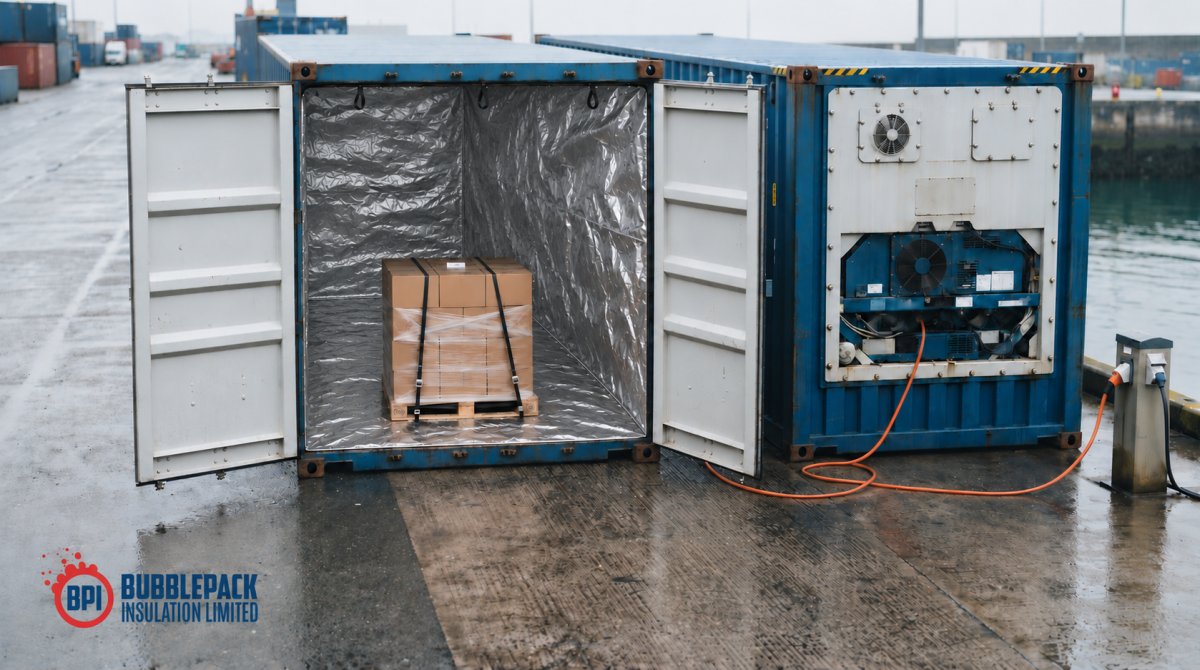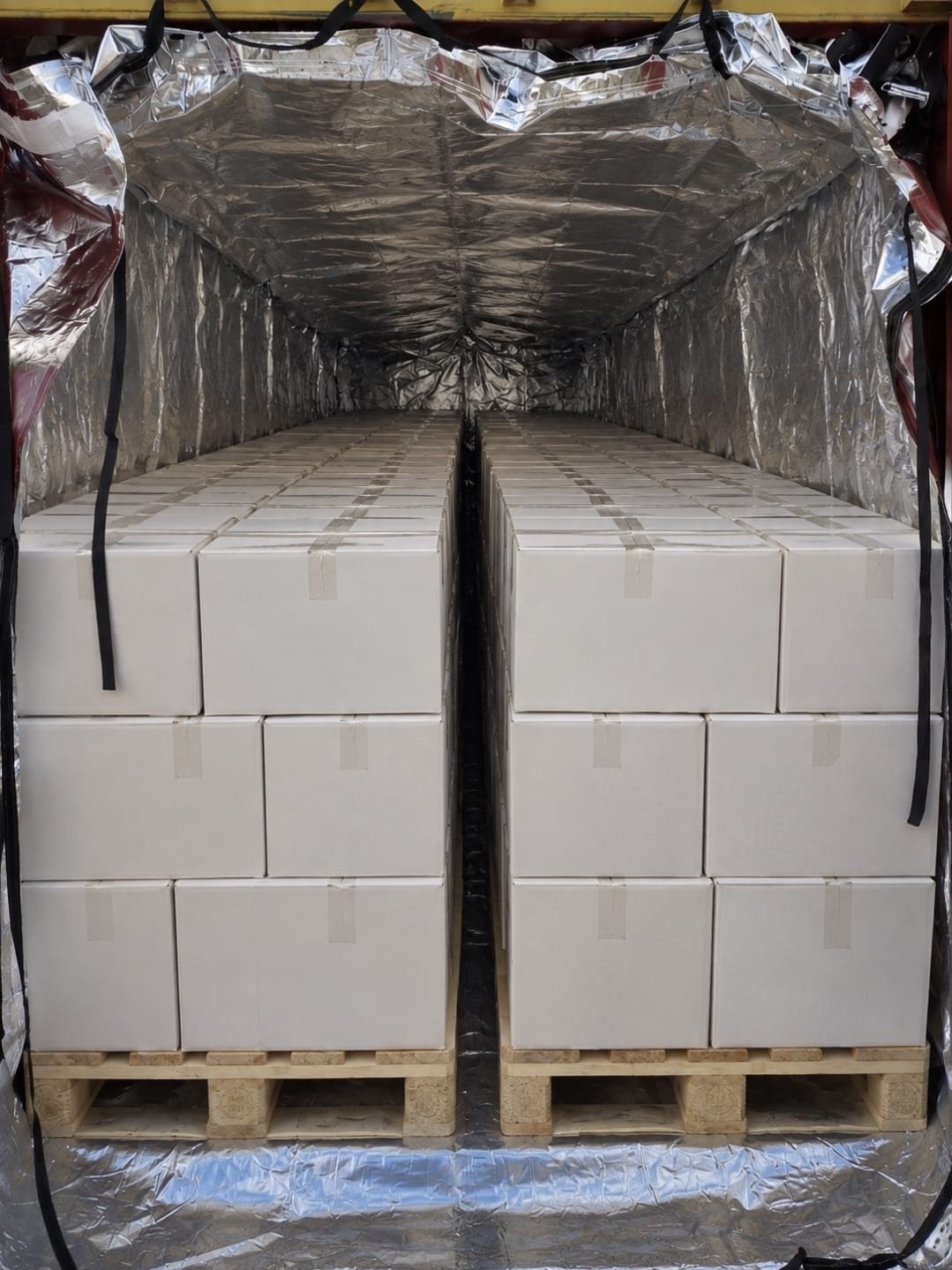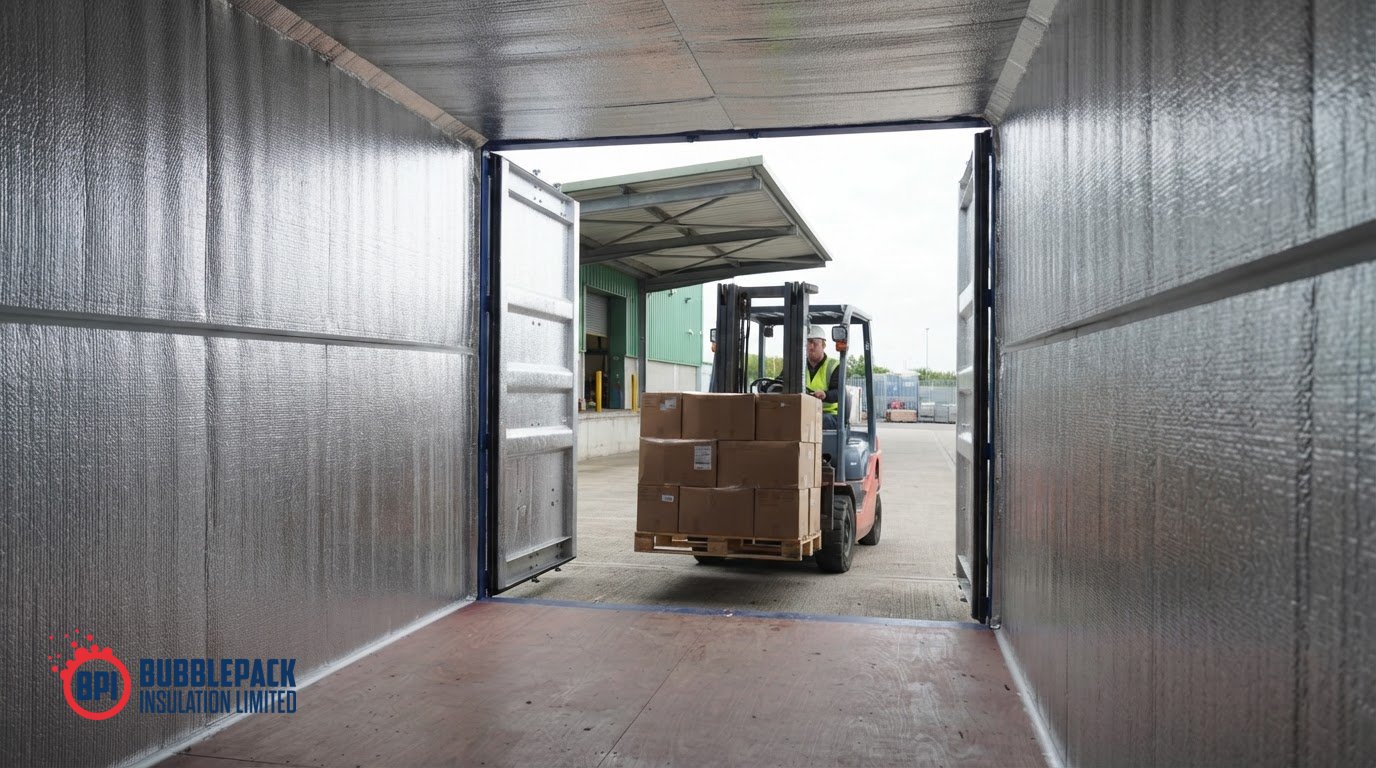
A thermal liner can moderate heat transfer during a container journey, but it does not actively control cargo temperature. Choosing a thermal container liner starts with the product’s documented temperature requirements and the conditions it will encounter in transit.
Exporters need protection suited to the shipment, without unnecessary complexity or materials. The right choice depends on cargo sensitivity, loading conditions, route, season and transit duration. Pharmaceutical shipments also require documented product requirements and appropriate shipper qualification.
This guide explains how to assess thermal container liners alongside practical protection needs, and why sustainability claims should be considered in context rather than assumed. It outlines how shipping duration and temperature ranges influence the choice, and why container liners are designed for cargo moving in shipping containers. It also clarifies the difference between passive insulation and active temperature control, helping you assess whether a thermal liner may suit an export shipment and what to consider before choosing a system.
Key Takeaways
• Choose between the Roll Liner and Integrated Liner based on the container, supply route and fitting arrangements that suit your shipment.
• Check the available container sizes and fitting times: liners are supplied for 20ft, 40ft HC and 45ft containers, with installation taking 20-45 minutes for Roll Liners and 7-20 minutes for Integrated Liners.
• Confirm the liner configuration and whether floor protection is included when planning container coverage.
• For an Irish Roll Liner installation, organise the container type, depot location, collection date, cargo requirements and fitting availability.
Assessing cargo suitability for ocean shipments
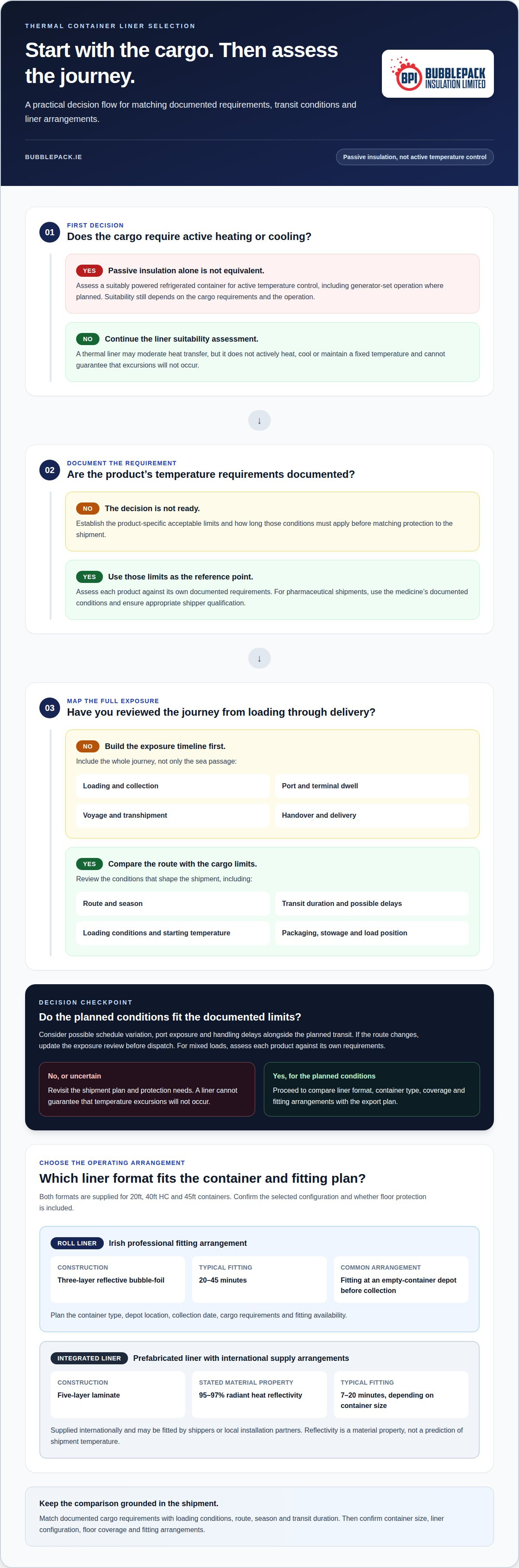
Start with the cargo’s documented temperature requirements, not a generic range. Record acceptable limits and how long those conditions must apply. A dairy ingredient, bottled beverage and pharmaceutical product may each have different requirements. A thermal liner provides passive insulation, not active heating or cooling. It cannot hold a fixed temperature or prevent every excursion. Suitability depends on the cargo, loading conditions, route, season and transit duration.
Estimate the full exposure window, not just the vessel’s sea passage. Include loading, collection, port handling, terminal dwell, voyage and delivery. A delay at either port can extend exposure beyond the schedule. Map seasonal conditions along the route, from origin to destination. Consider the load’s starting temperature, packaging, stowage and position inside the container. These factors shape the conditions surrounding the goods in transit. A destination forecast alone cannot represent the full journey.
Plan for possible schedule variation, not just the planned departure date. For example, cargo waiting to be loaded onto a vessel remains exposed at the terminal. Transhipment adds another handling stage and possible dwell time. Record planned connections, port calls and handover points for each route. Then compare this route map with the cargo’s documented limits. This helps identify gaps between planned transit and potential exposure.
Temperature excursions can affect product quality or usability. Their consequences depend on the cargo and exposure duration. Insulation cannot guarantee that excursions will not occur. Reduce risk by matching protection to documented limits and shipment conditions. Include contingency plans for route changes and handling delays. The protection required should reflect the cargo’s sensitivity, not simply the expected weather.
Use this assessment sequence for each export load:
• Document the cargo’s required temperature range and exposure limits.
• Build a timeline from loading through delivery, including port dwell.
• Review route, season and handling conditions at both ends.
• Match protection to cargo and operational requirements.
Compare the timeline with the product’s documented limits. If a shipment needs active heating or cooling, passive insulation alone is not equivalent. A suitably powered refrigerated container provides active temperature control, including through generator sets. Its suitability still depends on cargo requirements and the planned operation. When assessing a liner, consider how it may moderate heat transfer, but do not treat it as temperature control.
Keep the assessment traceable in the shipment plan. Record the product specification, loading condition, route assumptions and planned transit sequence together. If the route changes, update the exposure review before dispatch. This gives operations teams a practical basis for decisions. For mixed loads, assess each product against its own documented limits. Sharing a container does not make cargo requirements identical.
Thermal container liner options
Container-scale insulation liners differ from protection applied to individual cargo units. A full-container liner sits inside the shipping container, while pallet protection covers a defined load unit. Choose the format according to the cargo arrangement and required coverage. For container liners, the configuration also determines whether floor protection is included. Confirming this helps align the selected coverage with the loading plan.
A roll-format liner uses a three-layer reflective bubble-foil construction. Its installation is professionally arranged, typically taking 20-45 minutes. For Irish shipments, fitting is commonly scheduled at an empty-container depot before collection. This supports exporters who need the container prepared before loading. The installation schedule needs to fit the depot and collection arrangements, so container availability forms part of the planning.
A prefabricated integrated liner uses a five-layer laminate. Its stated radiant heat reflectivity is 95-97%, a material property rather than a prediction of shipment temperature. Typical fitting takes 7-20 minutes, depending on container size. The liner is supplied internationally and may be fitted by shippers or local installation partners. These arrangements can suit export operations with fitting requirements outside Ireland.
Both liner formats are supplied for 20ft, 40ft HC and 45ft containers. Identify the planned container type before selecting a configuration. Dimensions and coverage need to correspond with the equipment being prepared. Check whether the selected configuration includes floor protection, especially where the loading plan requires coverage beneath the cargo. Do not assume that every liner configuration provides the same coverage.
Roll format
three-layer reflective bubble-foil construction, with fitting typically taking 20-45 minutes.
Integrated format
five-layer laminate, with stated radiant heat reflectivity of 95-97%.
Container sizes
20ft, 40ft HC and 45ft.
Coverage
configuration-dependent, including whether floor protection is provided.
When reviewing specifications, distinguish material properties from expected cargo conditions. Reflectivity describes a property of the laminate; it does not establish the temperature a shipment will experience. Likewise, fitting duration describes installation, not transit performance. These distinctions help procurement and operations teams compare formats without treating a single specification as a complete measure of suitability.
For a practical selection, align the container type, coverage configuration and fitting arrangement with the export plan. Where the container is prepared before collection, depot timing matters. For international supply, fitting arrangements form part of the shipment planning. To discuss a suitable container liner configuration, contact the team about your shipment.
BubblePack Insulation
BubblePack Insulation helps exporters match a thermal container liner to the shipment and its preparation arrangements. Its options include the BPI Roll Liner and BPI Integrated Liner. Start by identifying where the container will be prepared and how fitting can be arranged. This distinction helps define the relevant option before planning fitting and collection.
For Irish exporters considering a Roll Liner, planning centres on coordinating the empty container with its depot schedule. Arrange the container type, depot location, collection date, cargo requirements and fitting availability. These details give the installation plan its operational context. A change to the collection date or depot can affect the arrangement, so keep those details aligned as the shipment plan develops.
The BPI Integrated Liner is a prefabricated option for international shipments. Shippers or local installation partners can fit it where arrangements are in place. This may be relevant when the container is prepared outside Ireland. Choose between the liner options according to where the container is prepared and how fitting fits into the export operation, rather than assuming one arrangement suits every shipment.
Both options are thermal liners for shipping containers, with the fitting arrangement depending on the product selected and where the container is prepared. Define the container and the area requiring liner coverage as part of the shipment plan. This helps keep the selection focused on the container itself and the preparation arrangements for the export operation.
Container preparation
identify the container type and where it will be made ready.
Collection planning
provide the intended collection date and depot location.
Cargo context
outline what is being shipped and its requirements.
Fitting coordination
include fitting availability in the operational schedule.
These planning details help identify the relevant container liner and fitting arrangement. They also distinguish an Irish depot installation from international supply. Keep the information together when discussing the shipment, particularly if container or collection arrangements change. Clear planning supports a focused discussion about the thermal liner format suited to the export operation.
For a shipment-specific discussion of thermal container liners, contact BubblePack Insulation.
Plan protection around your next shipment
Make protection part of export planning, not a last-minute addition. Align the cargo’s documented requirements with the container plan and practical fitting arrangements. This gives your logistics team a clear basis for choosing a thermal container liner, while recognising that passive insulation is not active temperature control.
BubblePack Insulation offers the BPI Roll Liner and BPI Integrated Liner. Each option provides container-level insulation. The next step is to match the relevant liner to the shipment and coordinate it with your loading plan.
Share the shipment context with the team, including the cargo requirements and intended container arrangements. A focused discussion can help establish which liner is relevant to your export operation. Discuss your shipment with BubblePack Insulation and take the next step towards a considered container insulation plan.
Frequently Asked Questions
What are thermal shipping solutions and how do they work?
Thermal shipping solutions include passive insulation and active temperature-controlled equipment. For container exports, a liner adds an insulating layer inside the container, while pallet protection applies at cargo-unit level. Choose protection according to the area exposed and the shipment’s handling plan. Passive insulation moderates heat transfer; it does not create cooling or maintain a temperature setpoint.
How do thermal shipping solutions compare for cold, frozen, and ambient shipments?
Choose according to the product’s documented requirements, rather than labelling a shipment simply cold, frozen or ambient. Ambient goods may still need insulation against route-related heat or cold. For frozen cargo, or any product requiring a controlled setpoint, assess active temperature control. A liner provides passive protection rather than active temperature control. The route and loading plan also matter.
How do I assess a thermal container liner for export cargo?
Assess the cargo’s documented temperature requirements alongside the loading conditions, route, season and transit duration. A thermal container liner provides passive insulation, not active temperature control, so check whether that level of protection is suitable for the shipment. Pharmaceutical shipments require documented product-specific temperature requirements and appropriate shipper qualification.