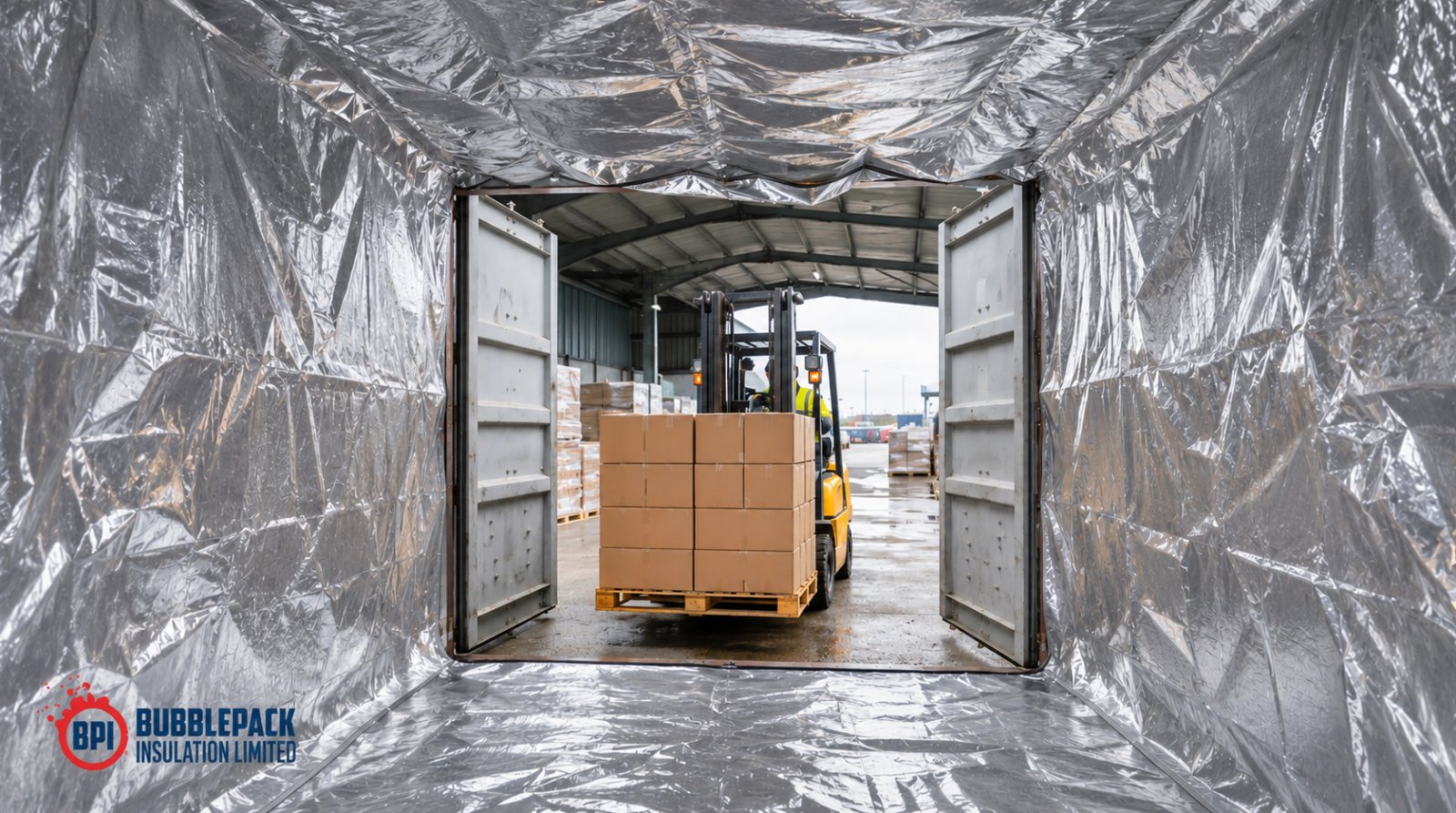
More temperature control is not always the right answer for export cargo. Choosing a passive liner versus a reefer container depends on the product’s documented requirements and expected transit conditions: a liner provides passive insulation, while a suitably powered reefer actively controls temperature.
It is understandable to favour active control for a temperature-sensitive shipment. But a liner is not a cooling system and cannot maintain a fixed temperature. Passive solutions that use pre-conditioned coolants are a separate approach. This distinction matters when assessing cargo exposure, route conditions and the level of temperature control the shipment needs.
This comparison explains how reefers and thermal container liners differ in temperature management, insulation and coolant use, and when each may suit an export shipment. It also offers a practical way to weigh product requirements, loading conditions, route, season, transit duration and risk tolerance before choosing an approach.
Key Takeaways
• Distinguish active temperature control from passive insulation when comparing a reefer with a container liner.
• Assess delay risks in context: a suitably powered reefer can continue controlling temperature, while a liner cannot maintain a set temperature.
• Match the shipping approach to the cargo’s documented requirements, loading conditions, route, season and transit duration; pharmaceutical shipments also require appropriate shipper qualification.
• Understand how port exposure affects the decision and where BubblePack’s Roll Liner and Integrated Liner may provide passive cargo protection.
Temperature maintenance during transit delays
A delay extends the time cargo is exposed to external conditions, but does not automatically interrupt a powered reefer’s temperature control. A passive liner slows heat transfer without actively controlling cargo temperature.
Cargo Temperature Requirements
Use the product’s documented transport conditions to assess exposure during a delay. Fresh produce is typically transported between 0°C and 13°C, depending on the product. That range is not a universal setting: the cargo specification determines the relevant conditions. Pharmaceutical shipments require product-specific documented requirements and appropriate shipper qualification, rather than a general temperature band.
Airflow and Temperature Distribution
A reefer actively controls its internal temperature when suitably powered. A passive liner provides insulation, not active temperature management. Do not treat a liner as a way to correct cargo loaded outside its required conditions. Compare the product’s documented requirements with the loading plan and expected delay, then choose the approach that fits the shipment’s tolerance for temperature variation.
Temperature sensors can report internal conditions in both active and passive arrangements. Monitoring provides visibility, but a sensor does not control temperature. Reefers need a suitable power supply, including a generator set where required; a delay alone does not mean power has been lost.
For pharmaceutical transport, EU GDP guidance and Ireland’s HPRA are relevant reference points. The responsible pharmaceutical business should align documented transport processes, product requirements, risk assessment and shipper qualification. Packaging must suit the product’s documented conditions; a liner alone does not establish GDP compliance.
| Option | Response during delay | Monitoring |
|---|---|---|
| Suitably powered reefer | Active temperature control | Internal temperature sensors can report conditions |
| Passive liner | Insulation without a set temperature | Sensors can report internal conditions |
Choose against the cargo specification, route and anticipated delay, not the container type alone.
Passive liners and active reefer containers
The key difference is control: a reefer uses powered refrigeration or heating to manage its internal temperature, while a liner provides passive insulation. Reefers suit cargo needing active temperature management, provided they are suitably powered. A liner can reduce the effect of external temperature changes, but cannot cool, heat or hold cargo at a set temperature.
There is no temperature range that a passive liner can maintain. Its effect depends on conditions such as the cargo’s starting temperature, loading and transit environment. Reefer capability varies by model: a standard 20ft reefer has a stated range of -30°C to +30°C, while a standard 40ft high-cube reefer has a stated range of -35°C to +30°C.
There is no single like-for-like cost. Reefer use can involve leasing, pickup and return charges; liner costs depend on the selected liner and fitting requirements. A liner quotation is based on the project and provided after a quote request. Container type, configuration and fitting arrangements inform the price.
Each option has limits. A liner has no powered temperature control, so prolonged exposure to temperature extremes can affect cargo despite the insulation. A reefer can actively manage temperature when suitably powered, but relies on its refrigeration or heating equipment and power supply. Neither option removes the need to assess the product’s documented transport conditions.
For cargo that can tolerate passive protection, a liner may be a suitable alternative to active control; where maintaining a setpoint is essential, a reefer is the relevant option. Discuss liner requirements and request a quotation for your container and shipment.
Choosing a solution based on cargo requirements and risk
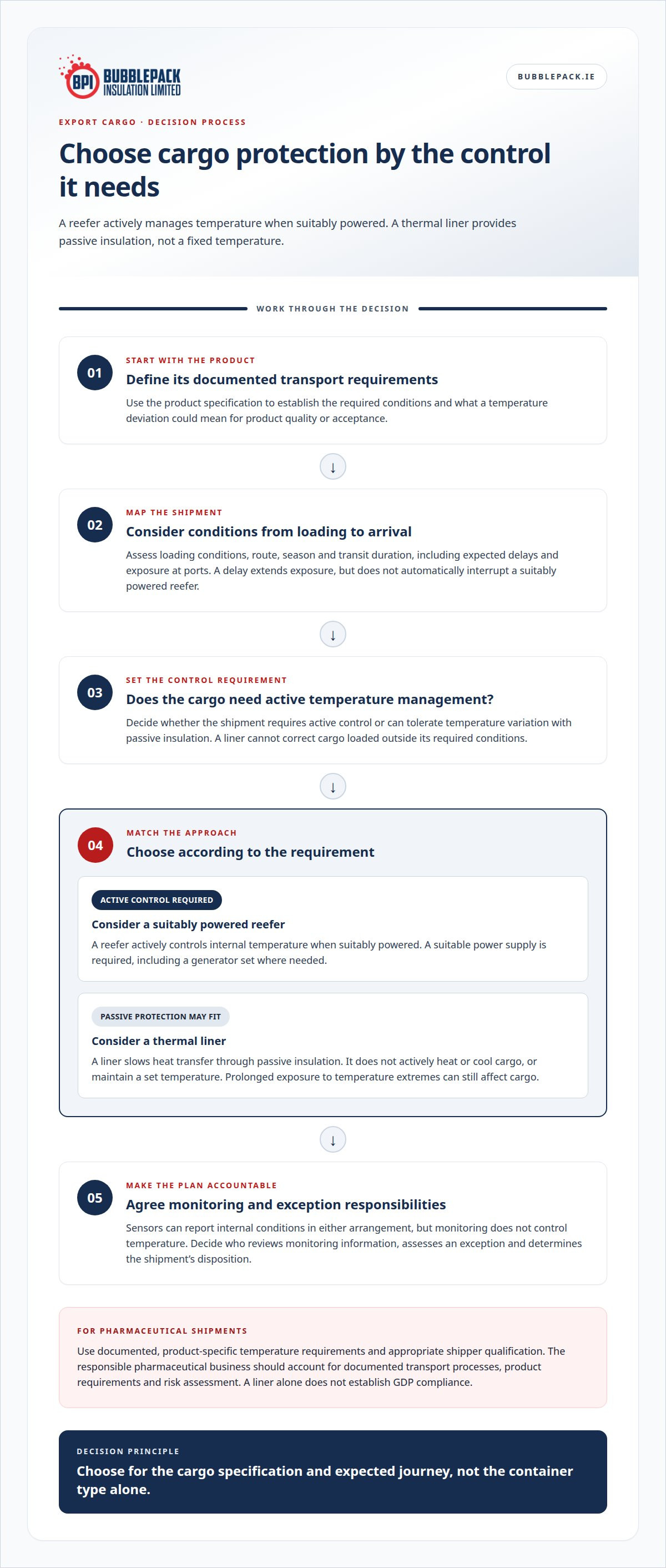
A sound decision starts by defining the consequences of a temperature deviation for the product and the business. Consider product rejection, quality impact and the ability to investigate a shipment concern. This helps the export team establish how much operational risk it can accept, rather than assuming one container type suits every cargo.
Next, define the required level of control. If the product needs active temperature management, a reefer is the relevant option. If considering passive insulation, account for the cargo’s tolerance for variation and the limits of that approach. A liner is not a substitute for active control when the product requires it.
For pharmaceutical shipments, the responsible shipper needs documented, product-specific temperature requirements and appropriate shipper qualification. The liner itself does not qualify a shipping arrangement or establish GDP compliance. The pharmaceutical business should incorporate its packaging choice into documented transport processes and risk assessment.
Risk appetite also depends on what the operation can do if a concern arises. Consider who receives monitoring information, who assesses an exception and how the shipment’s disposition is decided. Clear responsibilities help teams apply their chosen protection consistently, especially when several organisations handle the same consignment.
Use these decision checks with the product and quality teams:
• Define which temperature deviations require escalation or product review.
• Assign responsibility for monitoring information and exception decisions.
• Record why the selected protection matches the product’s accepted risk.
This gives procurement, quality and logistics teams a documented basis for choosing cargo protection that aligns with operational risk.
Ocean-route exposure and cargo suitability
Ocean shipments encounter changing conditions between loading and delivery. A container may wait at an origin terminal, transfer between vessels or remain at a destination port before collection. These stages extend exposure to local weather, so assess the entire route rather than sea transit alone.
At a port, ambient heat or cold can affect the container’s external environment. A suitably powered reefer actively controls its internal temperature during these stages, including when supported by a generator set. A thermal liner provides passive insulation against heat transfer, but cannot actively cool or heat cargo. A port delay alone does not mean a reefer has lost control.
Compare each route segment with the cargo’s documented transport conditions. A shipment crossing different climates may face different external conditions at origin, during transhipment and at destination. Cargo loaded outside its required conditions presents a separate risk: insulation does not correct its starting temperature. Stowage and liner configuration also matter, including whether floor protection is included.
Build the route assessment around practical exposure points:
• Record expected terminal dwell and vessel transfers when estimating total transit duration.
• Consider seasonal conditions at each port, not only the origin and destination.
• Check that the selected container approach matches the cargo’s permitted temperature variation and loading conditions.
• For a reefer, account for suitable power during relevant transport and terminal stages.
This comparison helps identify whether active control is needed throughout the route or passive insulation fits the cargo’s tolerance. It also makes port exposure part of the cargo-protection decision, rather than an afterthought. For an export assessment centred on shipping container insulation, discuss your route and cargo requirements.
BubblePack Insulation
BubblePack Insulation supplies and installs thermal container liners for exporters considering passive thermal protection. Its liners provide insulation, not active cooling or temperature control, so they suit shipments whose documented requirements and route conditions allow for a passive approach. For cargo requiring active temperature management, a reefer remains the appropriate type of solution.
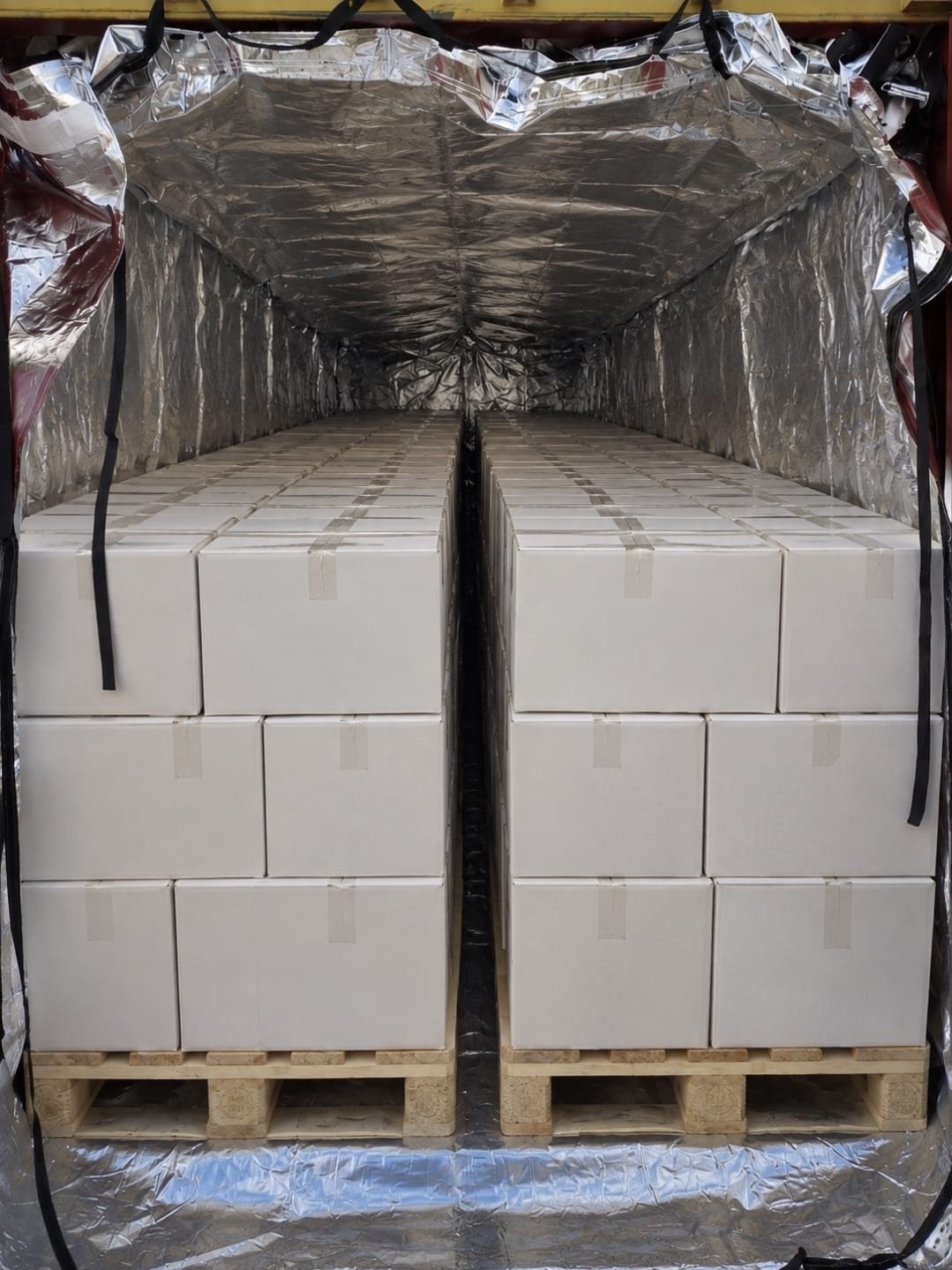
The BPI Integrated Liner is prefabricated for international supply and fits 20ft, 40ft HC and 45ft containers. Its five-layer laminate has 95-97% radiant heat reflectivity. Typical installation takes 7-20 minutes, depending on container size, and shippers or local installation partners can fit it where arrangements are in place. Container coverage depends on the selected configuration, including whether floor protection is included.
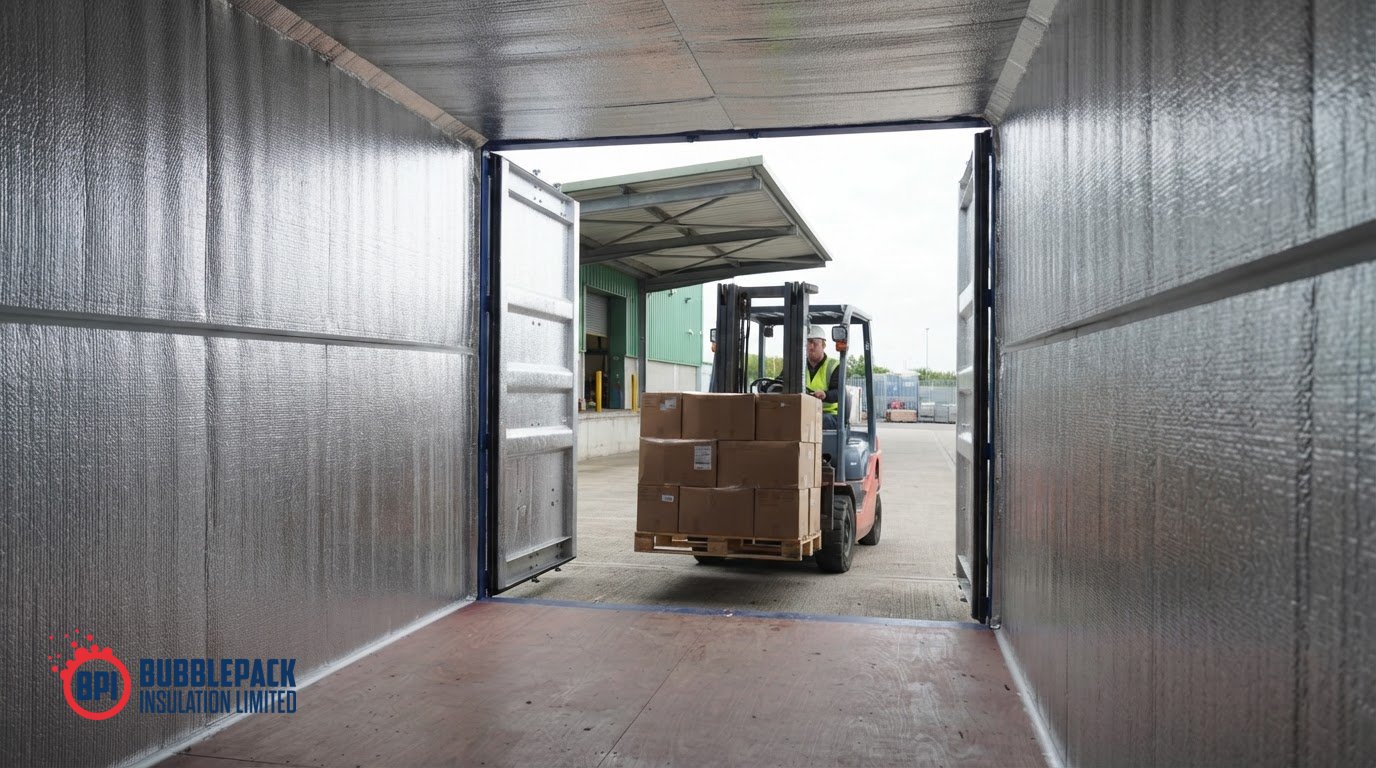
For exports arranged in Ireland, the BPI Roll Liner is reflective bubble-foil insulation with a three-layer construction. BubblePack’s technicians professionally supply and install it across Ireland, typically taking 20-45 minutes. Exporters need to arrange the container type, depot location, collection date, cargo requirements and fitting availability. Installation is commonly scheduled at an empty-container depot before collection. Both options provide insulation rather than active temperature control, so suitability depends on the shipment’s requirements.
Share the cargo requirements, container type, route and collection timing when discussing a project. This helps establish whether a thermal liner is suitable and which configuration to consider. For pharmaceutical cargo, the documented product conditions and appropriate shipper qualification remain essential to the transport plan. Find details of thermal container liner options relevant to export shipments.
Contact BubblePack Insulation to discuss your cargo and container requirements.
Put your next export plan into practice
Use the decision as an opportunity to align cargo protection with export planning. Before the next booking, bring the product specification, loading plan and intended route into the same discussion. This helps your team assess how the transport choice fits handling procedures and operational risk priorities, rather than treating equipment selection as an isolated procurement decision.
The choice of a passive liner versus a reefer container can also shape how responsibilities are coordinated across the shipment. Export, logistics and quality teams can agree who owns each requirement, what information needs to travel with the cargo, and how the selected approach fits existing processes. Clear ownership supports consistent decisions across future consignments.
BubblePack Insulation can help assess whether its thermal liner options fit your export cargo and container plan. Share the relevant shipment details to discuss the next step, bearing in mind that passive insulation is not right for every product.
Start a conversation with BubblePack Insulation about your upcoming shipment and move forward with a clearer protection plan.
Frequently Asked Questions
What are reefer containers?
Reefer containers are freight containers with refrigeration equipment for temperature-sensitive cargo. When suitably powered, they provide active temperature control. The shipping instruction should identify the product’s required carriage conditions so the equipment can be set appropriately. Export teams should align the container booking with cargo documentation and the shipment’s transport arrangements.
How do I choose between a thermal liner and a reefer?
Assess the cargo’s documented temperature requirements, loading conditions, route, season and transit duration. A reefer provides active temperature control when suitably powered; a thermal liner provides passive insulation and does not maintain a set temperature. Match the choice to the consignment’s requirements and document the reasoning in the export plan rather than relying on a generic option.
Which is better?
Neither option is universally better; suitability depends on the shipment. Compare each approach against the cargo’s documented requirements and how the shipment will be managed, including whether active temperature control is needed. Record the reasoning in the export plan so procurement, quality and logistics teams share the same basis for their decision.
How does a reefer container work?
A reefer’s refrigeration equipment responds to a selected temperature setting when the container has suitable power. Before dispatch, align the requested setting with the cargo’s carriage instructions. The team arranging the shipment should account for how power will be supplied across the planned transport stages, so the operating arrangement is clear before loading.
What is the difference between a passive liner and a reefer container?
A reefer uses powered refrigeration equipment to provide active temperature control when suitably powered, while a thermal liner provides passive insulation inside a container. This affects procurement and shipment preparation: assess whether the cargo requires active temperature control or whether passive insulation is suitable, then align the choice with the documented cargo requirements.
How long can a passive liner keep cargo within its required temperature range?
There is no fixed duration that applies to every shipment. Assess suitability against the product’s documented conditions, loading conditions, route, season and planned journey before relying on passive insulation. Relevant shipment records can inform future planning. Reassess the decision whenever the cargo, route or season changes.